Reduce Workplace Conflicts with Cultural Communication Strategies


Check out professional development opportunities that will enhance your communication skills with co-workers and clients. The full details are here.

A practical, interactive webinar facilitated by a TEFL Certified teacher, experienced diversity trainer and intercultural communication specialist, Evelina Silveira. View the complete outline here.

Do you or an employee struggle to sound professional? Maybe they are too harsh or aggressive. Learn more here.

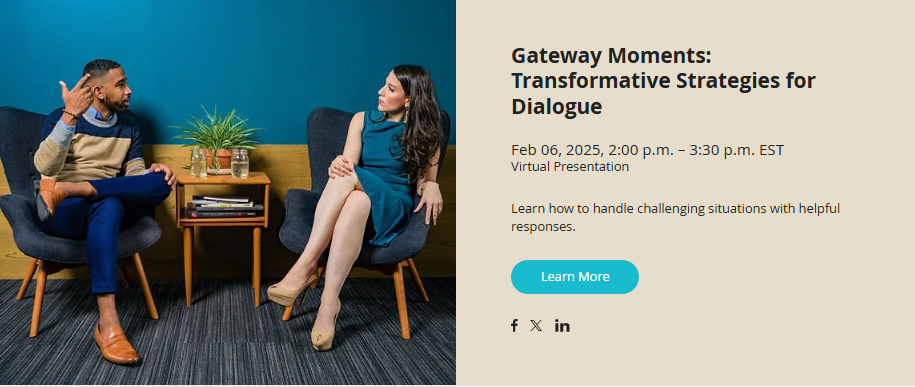
Reduce conflicts and bias while opening the doors to authentic dialogues. Learn more

To learn more about these webinars, click on the links. Please note registration closes two business days before the scheduled date. Inquire about having this webinar delivered in person or at a time that fits your organization’s schedule. Email evelina@diversityatworkcommunications.com

WEBINAR: English Pronunciation Boot Camp


There is nothing wrong with having an accent — we all have one.  But are you shying away from speaking because you’re conscious of how you sound? Are you often misunderstood due to your pronunciation? Are you constantly facing calls to repeat? Then, making your speaking clearer could be the answer.

Whether you’re an English learner or a native speaker wanting to improve your speech, we have the right tool for you.

 Join our English Pronunciation Boot Camp, an interactive and highly accessible webinar, where you will discover practical ways to refine your English pronunciation and sharpen your clarity in communication.  

During this hands-on session, you’ll engage in intensive, fun exercises that will dramatically help to improve your pronunciation skills. Regardless of your language proficiency level, we’ll cover basic to complex pronunciation principles, ensuring your words are clearly heard and understood by your audience.  

This is the next best thing if private coaching is not in your budget. 

Three different dates and time zones are available.

Check out the details at:

LEARNING OPPORTUNITIES – Fall 2022


DIVERSITY COMMITTEES: Everything You Wanted to Know

September 9, 2022

Photo by fauxels on Pexels.com

Have you thought about starting a DEI committee but don’t know where to begin? Are you struggling with your current one and wonder what you could do differently? DEI committees can be influential change agents when structured with a purpose and have built-in accountability.

In this webinar, you will learn:

– The benefits of a DEI committee;
– Ways of naming your committee;
– The essential components for a productive and harmonious diversity committee;
– What to include in a Terms of Reference;
– How to  select your  members;
– Troubleshooting common issues;
– Ways to overcome typical challenges;
– How to keep the momentum going;
– About schemes for evaluating your committee.


Learn more.

LANGUAGE BARRIERS: Tips for Inclusive Training

October 5, 2022

Photo by Canva Studio on Pexels.com
Learning the ropes in an organization is tough, but what if you have a language barrier?  You might not get the full benefit of training, compromising your performance and safety.   

That’s why it is incumbent upon trainers to be more creative in their approach and delivery to ensure participants receive equitable opportunities to succeed and contribute to the workplace.

Whether you conduct corporate training, deliver workshops or are training employees 1:1 you will gain new ideas to enhance your training and maximize their learning.

Topics will include:

–  Considerations for culturally sensitive design
–  Strategies for maximizing understanding
–  How to tell if someone has a language barrier
– Tips for making your speaking and writing clearer 
–  Useful tools for building materials that are easier to understand

This is offered in a live-one-hour presentation with opportunities for questions at the end

To learn more, visit.

WEBINARS – September 2020


Excited to announce our line-up of practically-based webinars which are sure to help you create a more inclusive workplace for you and your customers.

See our calendar. Click on the link to get the full details. https://www.diversityatworkcommunications.com/webinars


Would you like to receive the latest news about our professional development and publications?

Processing…
Success! You're on the list.

Great Customer Service Begins with Knowing How to Work with Language Barriers


coverEvelina Silveira, President, Diversity at Work

Customer service is about communication. A fruitful experience will result in both customer and agent satisfaction. Customer service training implies both the agent and the customer comprehend English, but that is not always the case.

According to Statistics Canada 2016, 2% of the Canadian population cannot speak English or French. The percentage is likely to soar, especially with recent news of mass migration and immigration proposed by the federal government.

Conditional on where you live, or the service you may provide, the percentage of people who lack English proficiency skills may be more substantial. Consider if you are a non-profit agency which delivers employment services to newcomers, or a store located in the heart of an ethnic community? All of these variations may result in a greater need for competencies in working with customer and clients who have language barriers.

While the encounter will be more challenging, it is not unmanageable. You can still provide courteous, attentive and results-oriented customer service. “Going-the-extra-mile” can contribute to customer loyalty; increased brand identification within a community; word-of-mouth advertising; but most of all, the satisfaction of providing them with what they want.

The various strategies and tips we will explore in this issue can be easily adapted to serving customers with learning and cognitive delays. Why? Patience, clear communication, and a willingness to “think-out-side-the-box” are requirements for reaching people with barriers.

In this issue of  Your Diverse Customer Training Ezine, you will learn how to communicate with people who have language barriers.

The contents of this issue include:

  • how to tell the difference between a strong accent and a language barrier
  • guide to reading letters and numbers over the telephone
  • common idioms to avoid
  • 8 Rules for Better Understanding
  • How to Make Your Communication Clearer
  • Case Study
  • Links to Training Resources


Purchase your Pdf version here:

Your Diverse Customer -Serving Customers With Language Barriers

$20.00

Meetings: A Tool Kit – New Immigrant Workplace Success Series


Evelina Silveira, President, Diversity at Work, London, Canada

meetingpromo

I am pleased to announce the release of my first tool in a series of resources to assist employers develop and retain new immigrant employees.  The  step=by-step exercises and processes will enhance your own coaching skills while empowering employees with vital information in a culturally relevant way.  I am sharing some of my coaching secrets and style which has resulted in many new immigrants enhancing their skills and employers retaining talent.

You can preview the toolkit below.  It is 31 pages in length and offers a 20-minute consultation with each purchase.  Buy it today and, begin having more productive meetings by developing your own and your employee’s  skills.  Feedback has been excellent!

Includes several handouts such as business idioms; checklist for inclusive meetings; coaching pre-assessments, low-risk no-stress ways to participate in meetings and more.

https://diversityandinclusionatwork.com/wp-content/uploads/2018/01/meetingspage1.pdf

https://diversityandinclusionatwork.com/wp-content/uploads/2018/01/secondpage.pdf

Meetings: A Toolkit Ebook

A 31-page toolkit which includes a 20 minute telephone consultation for each book sold.

C$225.00

9-1-1 Call Taker Simple Language Guide


Saving lives and providing equitable service to the public in crisis, just got easier!

Our 9-1-1 Police Call Taker Simple Language Guide was compiled with the help of three police services and research on call-taking protocols in the United States and Canada.  Learn how to probe about:

  • When
  • Where
  • Who
  • What
  • and Weapons

more simply. People who have low-English proficiency have an difficult time communicating when they are in crisis.  By using these phrases and words, call takers can save time and  obtain the information they need to dispatch an officer quickly.

For more information on pricing and bulk orders, contact info@yourdiversityatwork.com.

promocover

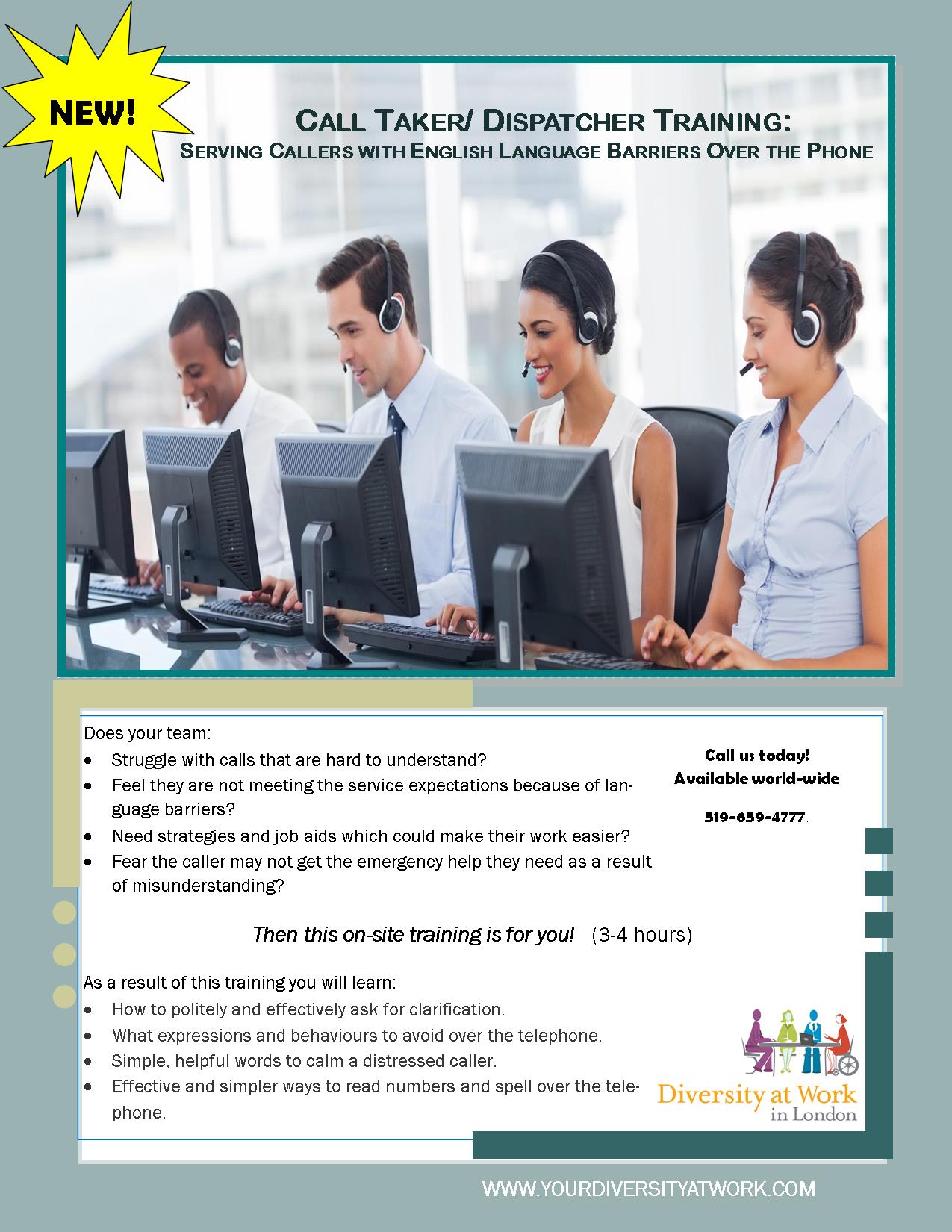
911 Call Taker Training


callerrevDo you currently work as a call taker?  Have you noticed the increase from callers who have low-English levels of proficiency? Chances are you have, as our research shows that call takers are receiving a larger call volume from this demographic.  The bad news?  You probably have never received any specific tips besides speak slowly and clearly.

This is when Diversity at Work’s training comes to the rescue.

You will learn everything on the flyer and much more.

We are pleased to report that participant evaluations consistently indicate that they feel their performance will improve as a result of taking this workshop.  The good part?  Even call takers with over 30 years of experience felt that way, too.

Call us today! We travel. Customization is available on request.

Reduce caller and call taker stress, triage calls effectively and provide a more equitable service.

To learn more about our business and the trainer, Evelina Silveira, please visit http://www.yourdiversityatwork.com.


How to Maximize Your Workplace Diversity: Conduct a Workforce Composition Survey


Introducing the Diversity at Work, Do-It-Yourself Workforce

Composition Survey Toolkit!


workforcesurvey


You would like to know more about your workforce, but you don’t know where to begin.

You’re intimidated by the process.

How do you make sure you ask the right questions?

How can you do this without hiring an expensive consultant?

If you have a skilled human resources team and a secure database — our D-I-Y Workplace Composition Survey Toolkit is for you.

The results will help you to determine:

If your workforce represents the community and clients you serve?

Are you meeting your Employment Equity goals?

Are you fully utilizing the education and training of your workforce?

Do your existing benefit and reward plans fit your current demographics?

What percentage of your workforce will be retiring soon?

Is your workforce representative of the community you work in?

Are you meeting your Employment Equity goals?

Are you fully utilizing the talents of your workforce?

And much more.

Testimonial from user:

“When we first started discussing a Diversity Survey, we didn’t know where to begin with questions and themes, let alone how to ensure the questions we were asking and the message we were delivering was politically correct and relevant to our employees. Evelina and Diversity at Work solved this problem for us by providing a Diversity Survey template, which we were able to modify based on our targeted outcome. This template saved us a tremendous amount of time and money, and also assured us that the survey content was respectful and aligned with our Shared Values.”

Tahlia Rimnyak, CHRP | Human Relations Coordinator
McCormick Canada

For more information and to purchase please visit:

http://www.yourdiversityatwork.com/classes/diyWorkForceSurvey.php


London’s Poor Diversity Score No Surprise


Written by: Evelina Silveira, President Diversity at Work

As featured in New Canadian Media
Thursday, 27 October 2016 

A recent study published by the Western University’s Centre for Research on Migration and Ethnic Relations found a severe lack of visible minorities in leadership roles in organizations in London, Ontario. 

While the study made headlines, the findings came as no surprise to me.  I have lived in London all my life, working as a diversity consultant for 10 years. I would like to offer an explanation as to why inroads have not been made in visible minority leadership in  London, Ontario.

Flashback to about 13 years ago, when I started to work on a business plan for Diversity at Work: I interviewed many leaders in London asking them whether my idea of having a business which promoted hiring and supporting diverse candidates would ever fly?

I will never forget the answer I received from a human resources consultant who had previously held many jobs in the recruitment and leadership fields.  She said:  “Evelina, as long as there are enough white people to fill the jobs, no one will ever consider anyone else, because they don’t have to.”

Essentially, she conveyed that there really was no need to change the recruitment process and that it was too much work to do so.

A late joiner

In comparison to other cities, London has lagged behind. Perhaps it is because the jobs could easily be filled as the human resources consultant suggested, or maybe we ignore the ever-growing presence of visible minorities which started in the mid-1980’s. 

Some of our largest employers and institutions have only recently developed diversity policies, later than their counterparts in other comparable cities which have a high number of visible minorities and immigrants. I often scan the diversity plans of the public service organizations in London and it would appear that the effort or the kind of approach being used – if at all – are not producing  much in terms of achieving a representative workforce, let alone diversity in leadership. 

My observations are consistent with the findings which indicate a very low level of visible minority participation, notably 5.3 per cent on agencies, boards, and commissions.  Their lack of participation at these levels can have ramifications for how services are delivered, in addition to resource allocation. 

Furthermore, there is a tendency, especially with boards, to recruit people they know, often friends and co-workers, to fill vacancies.  This can perpetuate the lack of representation and the effort to create more diversified boards and committees.

It is startling how many workplaces have not implemented the strategies and best practices that can help mitigate these gaps. How might we explain the disconnect? There is a multitude of reasons why this occurs and this is key to understanding the problem of under-representation in London’s publicly-funded organizations.

Consider these possibilities:

·         Foreign credentials and work experience are not recognized. Generally speaking, if an applicant has not graduated from a leadership program in North America or the U.K , there is a good chance their education in leadership may not be recognized.  Leadership experience from other  parts of the world may not be taken into consideration for a host of reasons, including cultural differences in how we do business and interact with employees.  

·         Effective leadership requires highly developed communication skills:  in person, in writing and over the phone.  An internationally-trained applicant is disadvantaged if they have a pronounced accent and have an indirect style of communication.  Interviewer bias can hamper heavily-accented applicants, who may be mistaken as unqualified because they speak differently.  Across cultures, there are variations in how we conduct meetings, presentations and write reports. The Canadian standards are often learned in school or through work experience.

At civic level: zero

The number of visible minorities and immigrant leaders in municipal organizations is at a glaring zero per cent! 

Given that government organizations are held to a higher standard than the private sector to have a reflective workforce, as well as to meet Employment Equity standards, this represents a failure of implementation and consequently lost opportunities for diversifying the workforce and gaining new skills and perspectives. 

With increasing job insecurity, good benefits and salaries, public service employees are not likely to leave their jobs.  Understandably, this represents fewer opportunities for external applicants to get hired. 

It would be interesting to know if the City of London has an internal mentoring program to assist aspiring leaders.  Research consistently indicates that visible minorities and immigrants find a lack of mentors in the workplace. 

Successful leaders often attest to the significance of mentors throughout their careers.  There have been some attempts over the last few years to develop internships for immigrant professionals at the City of London. However, it is hard to know if this experience translated into permanent employment with the City.

Finally, we cannot overlook bias and racism in the recruitment and selection process, although it does not probably explain the huge disconnect between the population and their representation in the workforce. In my experience, if the leadership in an organization is not familiar with the business benefits of a diverse workforce, they are very unlikely to support and initiate programs which can facilitate the entry and promotion of visible minorities within their organizations.

Evelina Silveira is the President of Diversity at Work in London, a three-time award -winning firm which specializes in creating inclusive workplaces and diverse customer bases.  She has co-authored two globally acclaimed books and is the publisher of the Inclusion Quarterly.
  • Sensitivity Empathy Training for Workplace Bullies

  • Enter your email address to follow this blog and receive notifications of new posts by email.

  • Workplace Inclusion and Customer Service Publications

  • Anti-Bullying and Harassment Training for Groups

  • Learn more about our English as a Foreign Language Coaching for Business Success

    Teacher Pointing at Map of World ca. 2002

  • Follow me on Twitter