LEARNING OPPORTUNITIES – Fall 2022


DIVERSITY COMMITTEES: Everything You Wanted to Know

September 9, 2022

Photo by fauxels on Pexels.com

Have you thought about starting a DEI committee but don’t know where to begin? Are you struggling with your current one and wonder what you could do differently? DEI committees can be influential change agents when structured with a purpose and have built-in accountability.

In this webinar, you will learn:

– The benefits of a DEI committee;
– Ways of naming your committee;
– The essential components for a productive and harmonious diversity committee;
– What to include in a Terms of Reference;
– How to  select your  members;
– Troubleshooting common issues;
– Ways to overcome typical challenges;
– How to keep the momentum going;
– About schemes for evaluating your committee.


Learn more.

LANGUAGE BARRIERS: Tips for Inclusive Training

October 5, 2022

Photo by Canva Studio on Pexels.com
Learning the ropes in an organization is tough, but what if you have a language barrier?  You might not get the full benefit of training, compromising your performance and safety.   

That’s why it is incumbent upon trainers to be more creative in their approach and delivery to ensure participants receive equitable opportunities to succeed and contribute to the workplace.

Whether you conduct corporate training, deliver workshops or are training employees 1:1 you will gain new ideas to enhance your training and maximize their learning.

Topics will include:

–  Considerations for culturally sensitive design
–  Strategies for maximizing understanding
–  How to tell if someone has a language barrier
– Tips for making your speaking and writing clearer 
–  Useful tools for building materials that are easier to understand

This is offered in a live-one-hour presentation with opportunities for questions at the end

To learn more, visit.

WEBINARS – September 2020


Excited to announce our line-up of practically-based webinars which are sure to help you create a more inclusive workplace for you and your customers.

See our calendar. Click on the link to get the full details. https://www.diversityatworkcommunications.com/webinars


Would you like to receive the latest news about our professional development and publications?

Processing…
Success! You're on the list.

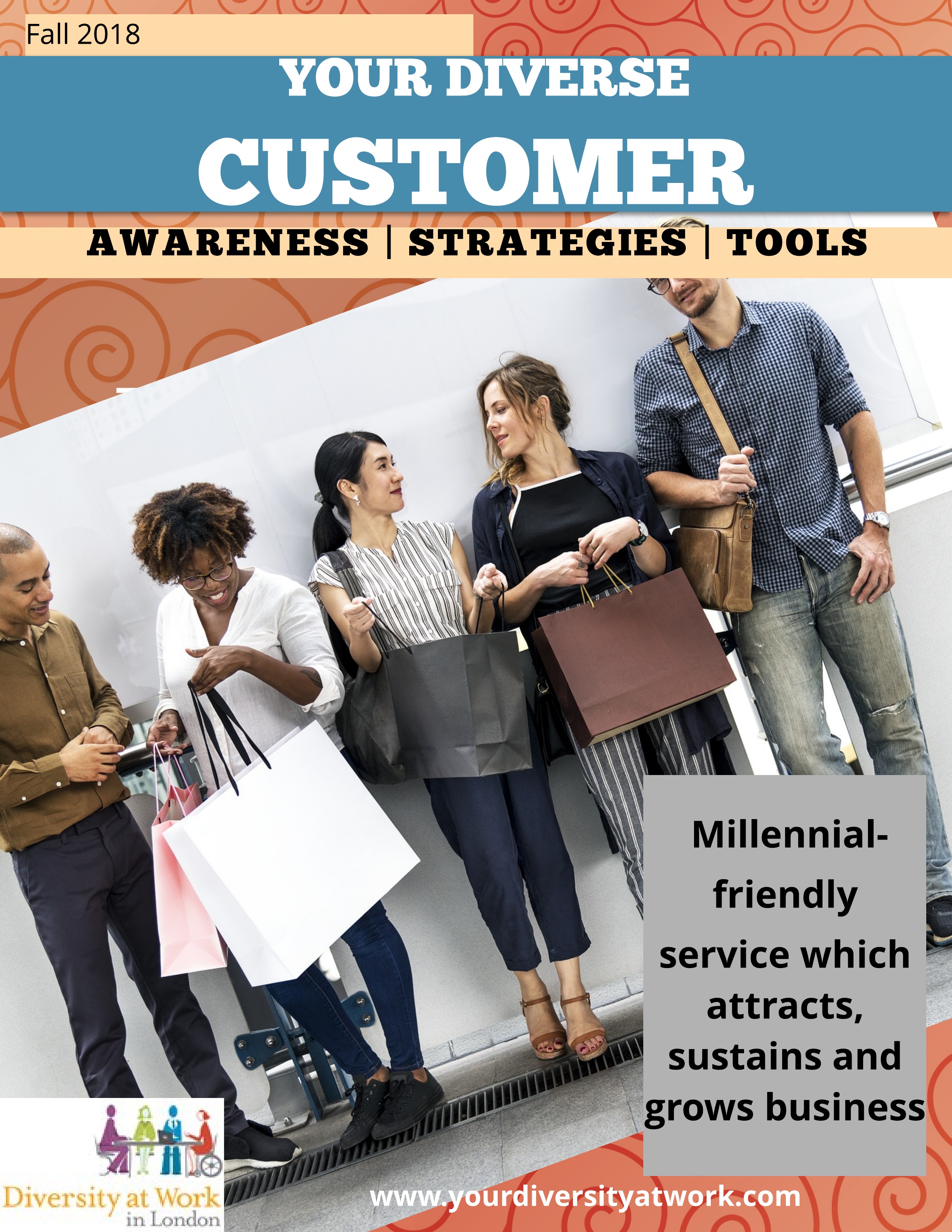
Millennial-Friendly Businesses Which Attract, Sustain and Grow Businesses


If you own a business or youfall 2018 -millennials - cover manage an agency, you will most definitely have Millennials serving your customers /clients. Traditional forms of training are ineffective. Written text is not the way to go! With the multitude of media these days, Millennials expect the training to be engaging, visually-pleasing, authentic and timely.

Remember, they are tech-savvy and lovers of visuals. They value authenticity and timeliness. Corporations like McDonald’s and Avon Canada are catering to this new group of entrepreneurs and workers. By providing online training and scheduling, most of the education process can actually take place in the comfort of the Millennial’s home.

Psychology Professor Christy Price from Dalton State University research concluded, there were 5 R’s to keep in mind.

  1. Research-based methods should be used along with collaboration and no lecturing.
  2. Relevant – information must be timely.
  3. Rationale – they need to know the reason behind the way things are done.
  4. Relaxed – They like laid back sessions with warm and empathetic trainers.
  5. Rapport – They prefer instructors who take a personal interest in them.


To learn more about how to serve, market and train millennials for an excellent customer service experience, purchase this issue of our new training magazine, Your Diverse Customer.

The topics in this issue include:

  • Why is the Millennial market so important?
  • What do Millennials expect when it comes from customer service?
  • Motivating Millennial Employees
  • 5 Different Kinds of Millennials
  • Resources
  • Website Checklist: Is Yours Millennial-Friendly


Your Diverse Customer – Millennial Issue

Pdf version of an eZine

$20.00


Diversity: Can we laugh, please?


smile-1491429_640

Evelina Silveira, President, Diversity at Work  http://www.yourdiversityatwork.com

If I believe my Twitter feed, I would say that the whole world is against people of my demographic. Diversity has become so serious, scary and divisive that we have forgotten how remarkably funny it can be if we do not think the world is out to offend us.

I want to share with you a few of my experiences because it is time we start seeing some of the humour of diversity misinterpretation and assumptions.

Several years ago, I received a call from a Caribbean man who was asking me if I would be interested in emceeing a black awards night.  I gladly accepted, impressed this was quite an open-minded group to invite me to facilitate the evening.  I wrote down the details, and just before I was about to hang up the phone, I had this strange hunch that came over me. Did I think maybe he did not want me – a white person?  I asked him directly: ” Michael, are you aware that I am not black?”  There was silence for a moment.  Then with an uncomfortable laugh, he responded “No.” I said, “I thought, so.” Does that make a difference now that you know that I am white?  After a momentary pause, he remarked: well, uh, yeah”. He was dumbfounded!  How was he going to tell me that he thought I was black and that is why he called me? Digging his heels, he told me that he thought I had a “black name” and that is why he called me.  I told him that I did not know what he was talking about:  a black name? Did I look black in my picture?  Trying to wheel himself out from the mess, he tried again and said:  “Well, I guess your name is Hispanic sounding!”  I told him: “Listen, I will make this easy for you.  You do not want me to emcee your event because I am white and by the way, I am not Hispanic –but close enough—Portuguese.  I wish you good luck trying to find someone!”

A former co-worker of mine who came out of the closet at work dealt with the homophobic men in the office in a unique way.  When he went into the men’s washroom, he would belt out the lyrics to “Dancing Queen”!

Acting as a cultural mentor for a Chinese new immigrant, I remarked about Canadian informality and pleaded with him to not call me Mrs. Silveira. I explained to him all of the instances when it is appropriate to use titles.  Running into him one day, I asked about his weekend. He said it was not so good and that he had to take his daughter to the hospital.  He noted how impressed he was with the care in a Canadian hospital.  With a mesmerized look on his face, he indicated he had put into action what I had taught him about informal salutations while he was in the hospital.  As he was leaving, he took a look at the doctor’s name tag which read:  “Sandy Brown.” In a great gesture of appreciation, exiting he said: “Thank you, Sandy.” To his dismay and surprise, she replied:  “Dr. Brown”!  I apologized to my dear friend for a significant omission – doctors and titles! Ouch!

All of these new genders are confusing me. I am not sure that I like the images that come to my mind like when I hear the word “gender fluid”. When I hear that expression, it makes me think that you have to go to the pharmacy to buy something to take care of it – maybe in the special paper products section in the store.  May I suggest “gender elasticity” or “gender flexibility” instead?

I have many stories about encounters in Asian food markets. Frequently, the employees that I come across don’t speak English, and therefore there is much room for misinterpretation.  Excited about embarking on a Vietnamese culinary adventure, I headed to the store looking for the best sauce to complement the spring rolls I was planning to make.  I saw a Chinese man who was stocking the shelves and asked him if he could recommend a good sauce for my spring rolls. I said I wanted him to show me the sauce he used. Clearly, he did not understand what I had said.  Before you knew it, we were standing in front of the Heinz ketchup.  I surmised that he likely thought this was the only kind of sauce white people use!

Whether it was one too many coffees or not enough sleep the night before, I had a twitch in my right eye during a workshop I was facilitating. It was distracting and it seemed like I could not control it. Moreover, for whatever reason, each time I looked in the direction of one of the female participants, my twitch became a wink.  Low and behold, after the training session, I went up to speak to some participants that were in her area. She immediately distanced herself and appeared uncomfortable.  The moral of the story: just because someone has a twitch does not mean he or she are flirting with you!

While running a Latin American seniors’ drop-in many years ago, the participants would cheerfully greet me with: ” Como estas, Evelina?”  (How are you, Evelina)  Reciprocally, I would reply “ Yo estoy buena, gracias.” I did this for months, thinking that I was saying:  “I am good, thank you.” A few of the older women would consistently give me strange grimaces.  One day we had two new participants from Colombia attend who decided to test me again and ask me how I was.  I gave them the same response, only this time they started laughing!   I realized that the “good” wholesome feeling I was trying to express, had, in fact, some other less innocent connotation!

After finishing my presentation about living with ADHD, I had a blind man come up to me and say:  “Wow!  I really feel sorry for you, it must be difficult bouncing off the walls all the time!”  I laughed and corrected him that I don’t bounce off walls too often but appreciated his empathy–even though I felt he was the one with the challenges!

It is time to bring the joy and laughter that diversity can bring! Feel free to share your funny incidents below.
 

The Guide to Workplace Inclusion


Preview and Purchase at www.yourdiversityatwork.com/ebook/

Read  below what others have said about our book:

linked in

ENDORSEMENTS:

This is an important and timely book for those who want more inclusive workplaces. It moves seamlessly from concepts and terminology and translates them into practical and actionable ideas. All readers, no matter where they are on their diversity and inclusive journey, will find something valuable in this book. Evelina Silveira and Jill Walters have created an impressive resource that includes examples of promising practices from across the globe. This should be every HR professional’s companion!

~Ratna Omidvar, executive director, Global Diversity Exchange, Ted Rogers School of Management, Ryerson University

The No-Nonsense Guide to Workplace Inclusion provides a thorough and engaging roadmap of the journey toward organizational inclusion. The authors write from a position of rich, credible experience, with the result that this Guide can help companies capitalize on opportunities and skirt problems on the road to fuller inclusion of an increasingly diverse workplace. Filled with examples and evidence-based solutions, this Guide is a valuable tool for any organization working on building and strengthening its culture of inclusiveness.

~Alison Konrad, PhD, professor of organizational behaviour, Ivey Business School, London, Canada

Managing diversity and creating inclusive workplaces can seem like a daunting challenge for many organisations, but Evelina and Jill have produced a really accessible, highly practical guide to help organisations get going. What we particularly liked was that it was packed full of real examples and illustrations and lots of useful links and tools.

~Tracy Powley, director, Focal Point Training and Consultancy Ltd, United Kingdom

Because inclusion is one of the core values of the USTA, it is important for me to lead, motivate and work well with individuals of diverse backgrounds, capabilities and interests in order to achieve the outcomes we’ve set for ourselves. This book is a great resource for any organization looking to create a successful culture of inclusion.

~D.A. Abrams, chief diversity & inclusion officer, United States Tennis Association/ author, Diversity & Inclusion: The Big Six Formula for Success

This book goes a long way in addressing the systemic discrimination faced by the LGBTQ2 community in the workplace. It tells you what you need to do and gives you the resources to do it. It makes it easy for any workplace to become more inclusive in their hiring, recruitment and retention practices. I highly recommend it for every workplace.

~ Deb Al-Hamza, past president, Pride London Festival/ diversity social worker, Children’s Aid Society of London & Middlesex

I think this book is very comprehensive! There is very valuable information from ‘Foundations for creating an Inclusive Business Environment’ to ‘Best Practices in Diversity.’ I see the value for small to medium businesses that lack a dedicated human resources professional or lack the experience with implementing policies and procedures to promote an inclusive environment; however, larger businesses can also benefit greatly from the examples, detail and strategy offered. I will continue to visit many of the resources offered in the future and have made note of some of the examples.

~Lesley Oliver, diversity & accessibility coordinator, Equity & Human Rights Services, University of Western Ontario

The book is strategic, concrete and to the point. The various examples make it relevant to readers and practical. I also like the fact it is rooted in personal experiences and takes a holistic approach. The book makes one reflect on what is not obvious, helps avoid assumptions and discusses unconscious bias.

~Magali Toussaint, international career and cross-cultural coach/ diversity professional, Netherlands, http://about.me/magali.toussaint


POTLUCKS AND THE POLITICS OF FOOD IN THE WORKPLACE


Evelina Silveira, President, Diversity at Work   co-author,  The No-Nonsense Guide To Workplace Inclusion

potluck[1]

While splitting the check, B.Y.O.B, potlucks, and eating leftovers from the catered luncheon are routine in a Canadian workplace; by far this experience  is not an international phenomenon. While you may think your welcoming, kind gesture to “break bread” with a New Canadian co-worker is a good idea, don’t be surprised if they have a different interpretation. Food and eating can be a highly political affair. Political? Indeed – political! Let’s take a look at one of our most popular epicurean rituals which has stood the test of time.

Potlucks

Why do we have potlucks in Canadian society? Potlucks offer an inexpensive, easy way to feed large groups of people, while providing an assortment of food the guests may have never sampled. It’s about sharing: food, workload, and preparation.

What are the beliefs that sustain potlucks in Canadian society?

  •  Cooking is a chore and not many people like it and especially when it involves trying to please a number of people whose preferences are unknown.
  • If you want to have a gathering everyone should be “pitching in” financially and effort-wise. Food and entertaining is expensive and it shouldn’t be up to one person to do all of the work.
  • It’s more fun if we all help out and we can share the joy and responsibility.
  • Hospitality doesn’t need to be formal. You can still be hospitable and casual at the same time. Everyone can be a host. It doesn’t take a lot of skill, effort or rules.

How might these beliefs clash with people who are coming from countries which are more hierarchical, formal and collectivist?

In a big way! Although the price of food has increased dramatically, it is still widely accessible and  affordable by comparison to other parts of the world. We don’t have a lot of rituals around eating except for “eating on the run”, “fast food” and “Tim Horton’s”. With a growing acceptance of vegetarian and veganism what we eat these days is less based on social stratification and more inclined to be on preference.

North Americans tend to view food in a “profane” way as the famous sociologist Emile Durkheim would probably conclude. Food is ordinary and nothing special, has no associated rituals or beliefs to preserve its “sacredness”.

This would be in sharp contrast to the many New Canadians who are more likely to view food as “sacred”. They may have grown up learning how to cook with recipes passed down from the generations, or associate foods with symbolism and rich meaning and a wider array of festivals and celebrations. Some foods may be used for medicines or spiritual healing or to bring good luck or fertility. The “sacredness” of food means the act of eating is a“sanctified ritual”. For example, Jews and Muslims will refrain from eating pork products and the meat they eat must conform to “kosher” or “halal” standards. It means that the animals are slaughtered in a religiously prescribed way to enhance the sacredness of the food and thus the sanctity of eating.
Hospitality is a lost art in North America. If you have ever shared a meal for instance with an Afghan, a Portuguese, or an Arab family – the hospitality cannot be compared. You will be treated like royalty and no effort or expense will be spared. The goal is not to make the experience easy for the host, but just the opposite. By contrast, the host wants to show you how much you mean to them by going through lots of trouble and expense. You will not feel obliged to do the dishes nor would they want you to. They want you to relax and have them entertain you. You may actually feel that they have enlisted their whole family to make you feel comfortable. The experience is formal and every action is intentional. Good hosting skills lead to many benefits including: new jobs, connections, elevated status, marriage proposals, a strengthened ability to negotiate, but most of all preserving or enhancing one’s reputation.

Are potlucks a good idea in a North American workplace? It all depends. If you want to celebrate or show appreciation for a job well done you may come across as a cheap manager or employer – an insult to your New Canadian workers. Showing appreciation and respect for employees and especially those from more formalized cultures requires: a demonstration of effort; some expense and conveying their importance in the workplace which is not a bad approach to take with all of your employees. Is it?

  • Sensitivity Empathy Training for Workplace Bullies

  • Enter your email address to follow this blog and receive notifications of new posts by email.

  • Workplace Inclusion and Customer Service Publications

  • Anti-Bullying and Harassment Training for Groups

  • Learn more about our English as a Foreign Language Coaching for Business Success

    Teacher Pointing at Map of World ca. 2002

  • Follow me on Twitter