Reduce Workplace Conflicts with Cultural Communication Strategies


Check out professional development opportunities that will enhance your communication skills with co-workers and clients. The full details are here.

A practical, interactive webinar facilitated by a TEFL Certified teacher, experienced diversity trainer and intercultural communication specialist, Evelina Silveira. View the complete outline here.

Do you or an employee struggle to sound professional? Maybe they are too harsh or aggressive. Learn more here.

Reduce conflicts and bias while opening the doors to authentic dialogues. Learn more

To learn more about these webinars, click on the links. Please note registration closes two business days before the scheduled date. Inquire about having this webinar delivered in person or at a time that fits your organization’s schedule. Email evelina@diversityatworkcommunications.com

WEBINAR: English Pronunciation Boot Camp


There is nothing wrong with having an accent — we all have one.  But are you shying away from speaking because you’re conscious of how you sound? Are you often misunderstood due to your pronunciation? Are you constantly facing calls to repeat? Then, making your speaking clearer could be the answer.

Whether you’re an English learner or a native speaker wanting to improve your speech, we have the right tool for you.

 Join our English Pronunciation Boot Camp, an interactive and highly accessible webinar, where you will discover practical ways to refine your English pronunciation and sharpen your clarity in communication.  

During this hands-on session, you’ll engage in intensive, fun exercises that will dramatically help to improve your pronunciation skills. Regardless of your language proficiency level, we’ll cover basic to complex pronunciation principles, ensuring your words are clearly heard and understood by your audience.  

This is the next best thing if private coaching is not in your budget. 

Three different dates and time zones are available.

Check out the details at:

English as a Second Language in the Workplace: Don’t let it be a barrier to success


By Evelina Silveira

My name is Evelina Silveira; I am TEFL certified, a diversity trainer specializing in intercultural communication, a certified mediator, a trilingual speaker, and the president of my 18- year- old company.

I know that learning a language well enough to conduct business can be a challenge. Your time is precious as an adult, and you want results quickly.

I have worked as an English as a Foreign Language Teacher for over three years with various learners from Asia, South America, Europe and the Middle East. During this time, I have learned about the different struggles various linguistic groups experience.

No matter where English as a Foreign Language speakers reside, they encounter the same issues:

  • Lacking the opportunities to practice speaking English.
  • Completing grammar-intense English classes that did not emphasize speaking skills such as pronunciation or intonation.
  • Adopting non-native English-speaking teachers’ grammatical and pronunciation errors
  • Fossilizing errors
  • Feeling reasonably comfortable with writing but being afraid to speak in public.
  • Lacking the vocabulary and confidence to get their points across

If you have at least a lower intermediate level of understanding of grammar and speaking skills, I can help you to gain the confidence and proficiency you need to advance.

Private, customized sessions are available for individuals. Corporate inquiries are welcome.

All materials are provided. Sessions are delivered on Zoom or on Tencent for clients in China.

Contact evelina@diversityatworkcommunications.com to set up a no-obligation consultation.

Check out our endorsements and learn more

LEARNING OPPORTUNITIES – Fall 2022


DIVERSITY COMMITTEES: Everything You Wanted to Know

September 9, 2022

Photo by fauxels on Pexels.com

Have you thought about starting a DEI committee but don’t know where to begin? Are you struggling with your current one and wonder what you could do differently? DEI committees can be influential change agents when structured with a purpose and have built-in accountability.

In this webinar, you will learn:

– The benefits of a DEI committee;
– Ways of naming your committee;
– The essential components for a productive and harmonious diversity committee;
– What to include in a Terms of Reference;
– How to  select your  members;
– Troubleshooting common issues;
– Ways to overcome typical challenges;
– How to keep the momentum going;
– About schemes for evaluating your committee.


Learn more.

LANGUAGE BARRIERS: Tips for Inclusive Training

October 5, 2022

Photo by Canva Studio on Pexels.com
Learning the ropes in an organization is tough, but what if you have a language barrier?  You might not get the full benefit of training, compromising your performance and safety.   

That’s why it is incumbent upon trainers to be more creative in their approach and delivery to ensure participants receive equitable opportunities to succeed and contribute to the workplace.

Whether you conduct corporate training, deliver workshops or are training employees 1:1 you will gain new ideas to enhance your training and maximize their learning.

Topics will include:

–  Considerations for culturally sensitive design
–  Strategies for maximizing understanding
–  How to tell if someone has a language barrier
– Tips for making your speaking and writing clearer 
–  Useful tools for building materials that are easier to understand

This is offered in a live-one-hour presentation with opportunities for questions at the end

To learn more, visit.

Overcoming Language Barriers Over the Phone – WEBINAR


Offered on September 11 & 21

Photo by Breakingpic on Pexels.com

NOTE:  The content of this webinar has been originally delivered to over 400 participants  sector-wide across Canada, within a  3-hour workshop time frame.   Approximate length is 1 hours and 30 minutes.

In this interactive,  practically-based webinar you will learn how to: · Tell if the caller has a genuine language barrier or merely a heavier accent. · Understand and decipher common distorted pronunciation and grammatical patterns with helpful tips and tricks. · Speak more clearly. · Read numbers and spell using an ESL alphabet. · Tell what tense the caller is speaking. · Guide the caller to obtaining vital information. · Calm distressed callers with three simple words. · Deal with common stressors including impolite and uncooperative callers. ·  Simplify industry terms using clear language .Past participants have included:  9-1-1 call takers,   receptionists, intake workers, crisis centre workers, program coordinators, salespeople and police officers.
This webinar includes an electronic job aid.

Learn more and register at https://www.diversityatworkcommunications.com/events/webinar-overcoming-language-barriers-on-the-phone

WEBINARS – September 2020


Excited to announce our line-up of practically-based webinars which are sure to help you create a more inclusive workplace for you and your customers.

See our calendar. Click on the link to get the full details. https://www.diversityatworkcommunications.com/webinars


Would you like to receive the latest news about our professional development and publications?

Processing…
Success! You're on the list.

SERVING CUSTOMERS WITH LANGUAGE BARRIERS OVER THE PHONE


LIVE WEBINAR

June 10 and 12 2020

Here is a customer service training event you will not want to miss! Hone your cultural competency skills and create an excellent customer service experience every time.

NOTE:  The content of this webinar has been originally delivered to over 400 participants  sector-wide across Canada, within a  3-hour workshop time frame.   Approximate length is 1 hours and 30 minutes.

In this interactive,  practically-based webinar you will learn how to: 


· Tell if the caller has a genuine language barrier or merely a heavier accent. 
· Understand and decipher common distorted pronunciation and grammatical patterns with helpful tips and tricks. 
· Speak more clearly. 
· Read numbers and spell using an ESL alphabet. 
· Tell what tense the caller is speaking. 
· Guide the caller to obtaining vital information. 
· Calm distressed callers with three simple words. 
· Deal with common stressors including impolite and uncooperative callers. 
·  Simplify industry terms using clear language

Past participants have included:  9-1-1 call takers, receptionists, intake workers, crisis centre workers, program coordinators, salespeople and police officers.
Supplementary materials are available for purchase:
The 9-1-1  Call Taker Clear Language Guide  
Telephone Training Job Aids

NOTE:  Please be advised that each participant will require a unique password. Pricing is per participant. No sharing of codes is permitted. Participants who enter the webinar room without paying the registration  will be asked to leave.  Your co-operation is appreciated. This webinar is offered at half price. Thank you for supporting a small business during these challenging times.
If you have any questions, please contact   519-659-4777.  evelina@diversityatworkcommunications.com

Learn more and register at https://www.diversityatwork

communications.com/webinars

Contact Diversity at Work to arrange a convenient time for your organization to attend. 519-549-4777.

Serving Customers with Mental Illness with Dignity


Evelina Silveira, President, Diversity at Work

What is the first thought that comes to your minmental healthd when you hear the term “mental illness”? You probably think about a commercial which is promoting mental health or a person you may know who is struggling with an illness. Alternatively, we may be speaking about you. What we often forget is that people with mental illness come to our organizations and businesses looking for goods and services. For some, their disorder will not impede their interactions. However, for others, they may experience barriers which prevent them from initiating or completing a transaction with you.

These individuals whose symptoms are more visible may require a heightened level of sensitivity and patience as well as an out-of-the-box type of service. According to the Centre for Addictions and Mental Health in Canada (CAMH), mental illness is the leading cause of disability


The Life and Economic Impact of Major Mental Illnesses in Canada: 2011-2041. Prepared for the Mental Health Commission of Canada, they indicate 1 in 5 Canadians experiences a mental health or addiction problem. By the time Canadians reach 40 years of age, 1 in 2 is the number.

The alarming statistics indicate this is a large demographic –one that requires our attention to ensure we provide an excellent customer service experience, get their repeat business and generate customer loyalty.

Learn more about serving customers with mental illness is our issue of Your Diverse Customer Training Ezine.  The topics include:

  • What is mental illness?
  • Tips for conveying and receiving information.
  • Interview:  How to conduct how visits.
  • Template:  Customer assistance form. A tool for providing service for unpredictable customers.
  • De-escalation – Tips for avoiding potentially violent situations.
  • Application and Resources – Case Study, link to further videos and learning

Purchase your Pdf copy today!

Your Diverse Customer – Serving Customers with Mental Illness

$20.00


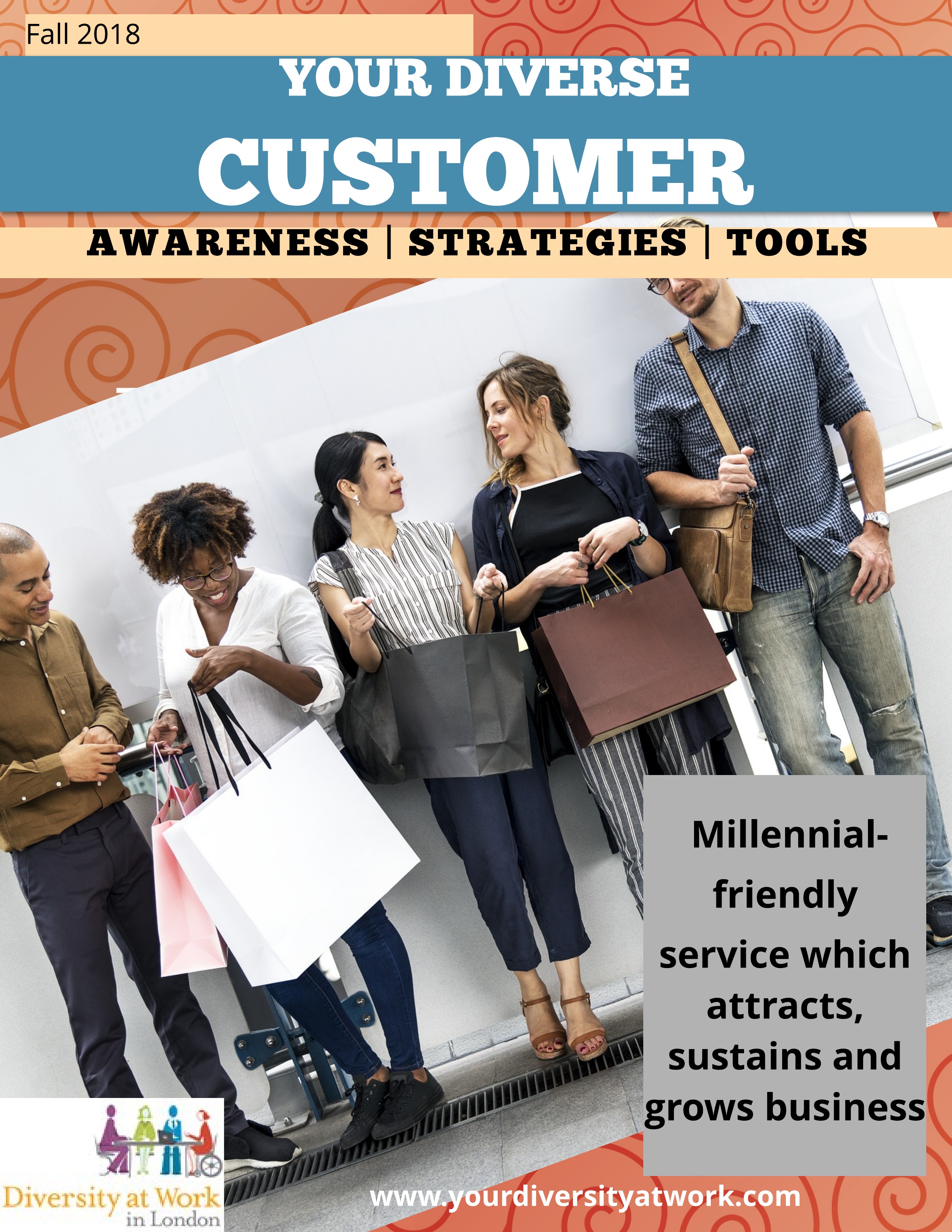
Millennial-Friendly Businesses Which Attract, Sustain and Grow Businesses


If you own a business or youfall 2018 -millennials - cover manage an agency, you will most definitely have Millennials serving your customers /clients. Traditional forms of training are ineffective. Written text is not the way to go! With the multitude of media these days, Millennials expect the training to be engaging, visually-pleasing, authentic and timely.

Remember, they are tech-savvy and lovers of visuals. They value authenticity and timeliness. Corporations like McDonald’s and Avon Canada are catering to this new group of entrepreneurs and workers. By providing online training and scheduling, most of the education process can actually take place in the comfort of the Millennial’s home.

Psychology Professor Christy Price from Dalton State University research concluded, there were 5 R’s to keep in mind.

  1. Research-based methods should be used along with collaboration and no lecturing.
  2. Relevant – information must be timely.
  3. Rationale – they need to know the reason behind the way things are done.
  4. Relaxed – They like laid back sessions with warm and empathetic trainers.
  5. Rapport – They prefer instructors who take a personal interest in them.


To learn more about how to serve, market and train millennials for an excellent customer service experience, purchase this issue of our new training magazine, Your Diverse Customer.

The topics in this issue include:

  • Why is the Millennial market so important?
  • What do Millennials expect when it comes from customer service?
  • Motivating Millennial Employees
  • 5 Different Kinds of Millennials
  • Resources
  • Website Checklist: Is Yours Millennial-Friendly


Your Diverse Customer – Millennial Issue

Pdf version of an eZine

$20.00


Great Customer Service Begins with Knowing How to Work with Language Barriers


coverEvelina Silveira, President, Diversity at Work

Customer service is about communication. A fruitful experience will result in both customer and agent satisfaction. Customer service training implies both the agent and the customer comprehend English, but that is not always the case.

According to Statistics Canada 2016, 2% of the Canadian population cannot speak English or French. The percentage is likely to soar, especially with recent news of mass migration and immigration proposed by the federal government.

Conditional on where you live, or the service you may provide, the percentage of people who lack English proficiency skills may be more substantial. Consider if you are a non-profit agency which delivers employment services to newcomers, or a store located in the heart of an ethnic community? All of these variations may result in a greater need for competencies in working with customer and clients who have language barriers.

While the encounter will be more challenging, it is not unmanageable. You can still provide courteous, attentive and results-oriented customer service. “Going-the-extra-mile” can contribute to customer loyalty; increased brand identification within a community; word-of-mouth advertising; but most of all, the satisfaction of providing them with what they want.

The various strategies and tips we will explore in this issue can be easily adapted to serving customers with learning and cognitive delays. Why? Patience, clear communication, and a willingness to “think-out-side-the-box” are requirements for reaching people with barriers.

In this issue of  Your Diverse Customer Training Ezine, you will learn how to communicate with people who have language barriers.

The contents of this issue include:

  • how to tell the difference between a strong accent and a language barrier
  • guide to reading letters and numbers over the telephone
  • common idioms to avoid
  • 8 Rules for Better Understanding
  • How to Make Your Communication Clearer
  • Case Study
  • Links to Training Resources


Purchase your Pdf version here:

Your Diverse Customer -Serving Customers With Language Barriers
$20.00

  • Sensitivity Empathy Training for Workplace Bullies

  • Enter your email address to follow this blog and receive notifications of new posts by email.

  • Workplace Inclusion and Customer Service Publications

  • Anti-Bullying and Harassment Training for Groups

  • Learn more about our English as a Foreign Language Coaching for Business Success

    Teacher Pointing at Map of World ca. 2002

  • Follow me on Twitter