February/March 2021 Webinar Calendar


Here’s a list of our signature webinars and content you will find no where else. Practical, engaging, with the goal of improving communication and customer service.

If you are interested in attending, please register at least two days in advance. Contact regarding customization or having a training event delivered in your timezone.

https://www.diversityatworkcommunications.com/workshopregistration

Be sure to sign up to receive regular updates about our training opportunities at https://www.diversityatworkcommunications.com/

Webinar Calendar


Check out our line-up of for December 2020 Webinars. If you would like to receive regular updates on our promotional events sign up at our website: http://www.diversityatworkcommunications.com.

Thank you!

Webinar: Understanding and Responding to Intercultural Conflict


July 10 or 16, 2020

With global business communications and diverse workplaces increasing, intercultural conflicts and misunderstandings are bound to happen.
Ethnocentric approaches  mistakenly  assert that all conflicts are pretty much the sameiand should be handled similarly. But, this is ineffective and does not take into consideration the uniqueness of various cultures.
Intercultural conflicts are different. 


Hone your cultural competencies skills and  learn to look at intercultural conflict from a ethnorelative lens.
In this webinar you will:

  • Learn how differences in cultural perceptions can trigger discord.
  •  Theories of intercultural conflict.
  •  Figure out if a conflict is culturally-based.
  •  Gain strategies for dealing with intercultural conflict when it arises.
  •  Understand how different cultures approach and resolve conflicts.   
  • Ways of preventing or minimizing intercultural conflict in the future.
  • Obtain specific questions for mediating intercultural conflicts in the workplace.

This is a condensed version of a one-day workshop.  
If you want to improve the communication skills among your global teams, culturally diverse clients or staff, this is for you!

Learn more and register:

https://www.diversityatworkcommunications.com/webinars

Webinar: Anger Management


July 13 or 18 2020

Keeping your cool at work is not always easy. If you are having problems with controlling your anger at work, you could be missing out on promotional opportunities, productive relationships and could risk having a bullying or harassment complaint laid against you.

Don’t you owe it to yourself and your co-workers to learn some new ways of behaving that are actually good for you?

Learn more and register for the webinar on July 13 here:

https://www.diversityatworkcommunications.com/events/webinar-anger-management-in-the-workplace

Learn more and register for the webinar on July 18 here:

https://www.diversityatworkcommunications.com/events/webinar-anger-management-in-the-workplace-2

Be sure to sign up for our email marketing list at www.diversityatworkcommunications.com

Processing…
Success! You're on the list.

SERVING CUSTOMERS WITH LANGUAGE BARRIERS OVER THE PHONE


LIVE WEBINAR

June 10 and 12 2020

Here is a customer service training event you will not want to miss! Hone your cultural competency skills and create an excellent customer service experience every time.

NOTE:  The content of this webinar has been originally delivered to over 400 participants  sector-wide across Canada, within a  3-hour workshop time frame.   Approximate length is 1 hours and 30 minutes.

In this interactive,  practically-based webinar you will learn how to: 


· Tell if the caller has a genuine language barrier or merely a heavier accent. 
· Understand and decipher common distorted pronunciation and grammatical patterns with helpful tips and tricks. 
· Speak more clearly. 
· Read numbers and spell using an ESL alphabet. 
· Tell what tense the caller is speaking. 
· Guide the caller to obtaining vital information. 
· Calm distressed callers with three simple words. 
· Deal with common stressors including impolite and uncooperative callers. 
·  Simplify industry terms using clear language

Past participants have included:  9-1-1 call takers, receptionists, intake workers, crisis centre workers, program coordinators, salespeople and police officers.
Supplementary materials are available for purchase:
The 9-1-1  Call Taker Clear Language Guide  
Telephone Training Job Aids

NOTE:  Please be advised that each participant will require a unique password. Pricing is per participant. No sharing of codes is permitted. Participants who enter the webinar room without paying the registration  will be asked to leave.  Your co-operation is appreciated. This webinar is offered at half price. Thank you for supporting a small business during these challenging times.
If you have any questions, please contact   519-659-4777.  evelina@diversityatworkcommunications.com

Learn more and register at https://www.diversityatwork

communications.com/webinars

Contact Diversity at Work to arrange a convenient time for your organization to attend. 519-549-4777.

Surprising Things You Might Not Have Known About Workplace Bullies


bullysmallEvelina Silveira, President Diversity at Work


One day lying in bed, a light bulb went on for me. Workplace bullies often struggle with the same issues as people who abuse their partners: anger management and poor communication skills. Alas, I realized that I had found the solution based on my previous experience as a Group Counsellor for a male batterer program.

I have developed a program for workplace bullies based on what I have learned from teaching anger management and communication skills to court-mandated clients who had domestic abuse charges.

Over the last 3 years, the demands for this service have escalated due to increasing awareness as well as protective legislation. People often ask me, what are they like?


I work with a very specific client group. Almost always, the workplace bully meets with me after an investigation. The bully employee has expert knowledge in their field and is highly valuable to the organization, thus losing them would have adverse financial effects on the workplace. The cost of my training is a bargain in comparison to losing an irreplaceable employee.

Usually, my clients are hard-working and good at what they do. But there are some definite characteristics which have rung true in almost every situation.


They are loyal employees. Bullies care about their workplaces and get angry when others do not care about it the way they do. These are the individuals who will “do things by the book.” Their rigidity means they like order and get upset when others deviate from it.


They have low self-esteem. Their opinion of themselves gets elevated when they intimidate others, especially if the other person complies with their wishes. Otherwise, they tend to be unhappy in their own skin. Most will disclose their family of origin was strict or conversely their parents felt they “could do no wrong.”


They do not take criticism easily. Workplace bullies take criticism extremely hard –especially the ones I deal with who excel at their given jobs. They can become defensive and tune out what the other person is saying. With a tendency to be selective listeners, bullies may hyper-focus on the negative or exaggerate the criticism.


They have poor self-care. Many of my clients will talk about a dependency on alcohol or substances. Others will medicate themselves with food. Poor self-care often translates into them working lots of unpaid over-time or not taking vacation. Constantly obsessing about work, bullies are worried about how the company will operate without them when they are away.

If you know an employee who needs to learn better ways of managing their anger and develop positive interpersonal skills, please contact me at: 519-659-4777 or Evelina@yourdiversityatwork.com. Learn more about this program at https://www.diversityatworkcommunications.com/sensitivity. Sign up for our promotions. Sessions usually take place face-to-face, however, online training is available upon request.

Do You Watch ‘The Office’? My Workshop Gets At The Toughest Communication Grime! (‘Manager Michael Scott’ Needs To Attend!)


the office


I loved The Office. I still watch it in re-runs. It lets me laugh about situations I’ve seen again and again in actual workplaces. It’s not funny in real-life; but it’s hilarious in ‘pretend’!

IN REAL LIFE, I wasn’t laughing when I dealt with:

  • A manager wrongly accused of racism by an under-performer
  • An employee who unintentionally offended a client
  • An outreach worker who wanted to disclose community trends to alleviate a social problem but couldn’t without being falsely labelled herself

Why do these issues arise? Because ‘Awareness Training’ is not enough.

A healthy, safe, fearless workplace requires AUTHENTIC LEADERSHIP. If you are an AUTHENTIC LEADER – or want to become one – then this workshop is for you.

What is an authentic leader? You’re confident, self-aware, and free to be yourself both publicly and privately. You see employees getting mired in political correctness, and the workplace climate being poisoned. You want to do something about it!

COMMUNICATION SKILLS FOR DIVERSE WORKPLACES: My original, 6-HOUR, interactive workshop delivers tools that authentic leaders need to create and support openness and dialogue in the workplace.

In The Office ‘Dunder Mifflin Paper Products’ office and warehouse, people said the wrong things and lived in fear. They walked on eggshells. But they lacked the leadership to behave and communicate more successfully. In one episode, a diversity exercise became a circus of cultural stereotyping! It was funny because it resonates with everyone. Real-life offices face the same issues, but it’s never funny.

As a real-world manager, you experience:

  • Real conversation stifled because of fear of offense or ‘triggering’
  • An increase in bullying and harassment complaints/investigations

PARTICIPANTS IN MY MOST RECENT WORKSHOP (Kitchener-Waterloo YMCA) loved the workshop. In anonymous feedback, participants praised it:

 “I’m more inclined to engage in an uncomfortable dialogue than before this workshop.”

 “I received tools to work through difficult diversity dialogues.”

“Evelina created an atmosphere of openness and allowed uncomfortable conversations.”

“My favorite part was the variety of exercises and sessions.”

“This Communication Skills workshop was well-organized, on-time, and engaging.”

“I really appreciated the openness of Evelina!”

“This workshop was excellent: All the topics related to bias.”

“My favorite parts were the conversations and discussions.”

“I liked how the views and suggestions really support healthy dialogues.”

“I liked group discussions, thought-provoking conversations, and real-life examples.”

Workplaces today are quick to embrace diversity, but good intentions lead to conflict and toxicity. Sondra Thiederman calls this ‘Guerrilla Bias.’ In a workplace that picks up buzzwords, employees learn to identify as victims who are unable to cope with alternate views. No workplace can function and operate properly or effectively in this type of climate.

Authentic Leaders teach Authentic Communication

My workshop equips leaders with the skills necessary for authentic and challenging dialogues. Once in place, differences can be leveraged correctly. Differences become actual benefits, instead of becoming sticks to beat colleagues.

No manager wants their workplace evolving into a real-life version of The Office!

Risk-averse leaders cement a culture of silence. Silence leads to resentment and toxicity, which negates the potential benefits of a diverse workforce! In the wrong environment, diversity becomes a liability instead of an asset.

It doesn’t have to be this way. This is where I come in.

I understand. I hate workplace conflict. Increased calls to my anti-bullying service means workplaces are heating up because workers have stopped talking – they are afraid.

Do you blame them? I don’t.

More and more laws pop up telling us what we can and can’t say. A glance at the media shows how one wrong step, word, or tweet leads to a full-scale social-media attack and demonization.

Again: It doesn’t have to be this way. I can help.

If you want to be an authentic leader, I created my workshop for you and your organization. You’ll learn to be THE LEADER willing to take risks for the greater good of the organization, and to be a POSITIVE-COMMUNICATION MODEL for your team.

The Nitty-Gritty of COMMUNICATION SKILLS FOR DIVERSE WORKPLACES:

  • A highly interactive, 6-hour workshop of my researched, original content
  • Self-reflection exercises for participants
  • Teamwork in small and large groups

But this workshop isn’t for everyone. Why? Because I challenge my participants! You won’t always feel comfortable, but discomfort is where awareness and learning begin.

YOU’LL LEARN:

  • Types of bias, and how personal bias shows up in the workplace
  • Best responses to comments/behaviours you believe are offensive
  • Approaches for justifiable accusations of bias or problematic behaviour
  • How to listen and genuinely understand someone

You’ll emerge with tools and strategies to have AUTHENTIC DIALOGUES, which are the lifeblood of constructive workplace relationships.

 Want to learn more? Interested in creating a GENUINELY authentic, diverse, and inclusive workplace? If you feel you’re an authentic leader, or that you want to learn how to become one, then this workshop is for YOU.

 Contact me to deliver this important workshop to you and your group.

Contact Evelina for more details at: 519-659-4777 evelina@yourdiversityatwork.com


Serving Customers with Mental Illness with Dignity


Evelina Silveira, President, Diversity at Work

What is the first thought that comes to your minmental healthd when you hear the term “mental illness”? You probably think about a commercial which is promoting mental health or a person you may know who is struggling with an illness. Alternatively, we may be speaking about you. What we often forget is that people with mental illness come to our organizations and businesses looking for goods and services. For some, their disorder will not impede their interactions. However, for others, they may experience barriers which prevent them from initiating or completing a transaction with you.
These individuals whose symptoms are more visible may require a heightened level of sensitivity and patience as well as an out-of-the-box type of service. According to the Centre for Addictions and Mental Health in Canada (CAMH), mental illness is the leading cause of disability


The Life and Economic Impact of Major Mental Illnesses in Canada: 2011-2041. Prepared for the Mental Health Commission of Canada, they indicate 1 in 5 Canadians experiences a mental health or addiction problem. By the time Canadians reach 40 years of age, 1 in 2 is the number.

The alarming statistics indicate this is a large demographic –one that requires our attention to ensure we provide an excellent customer service experience, get their repeat business and generate customer loyalty.

Learn more about serving customers with mental illness is our issue of Your Diverse Customer Training Ezine.  The topics include:

  • What is mental illness?
  • Tips for conveying and receiving information.
  • Interview:  How to conduct how visits.
  • Template:  Customer assistance form. A tool for providing service for unpredictable customers.
  • De-escalation – Tips for avoiding potentially violent situations.
  • Application and Resources – Case Study, link to further videos and learning

Purchase your Pdf copy today!

Your Diverse Customer – Serving Customers with Mental Illness

$20.00


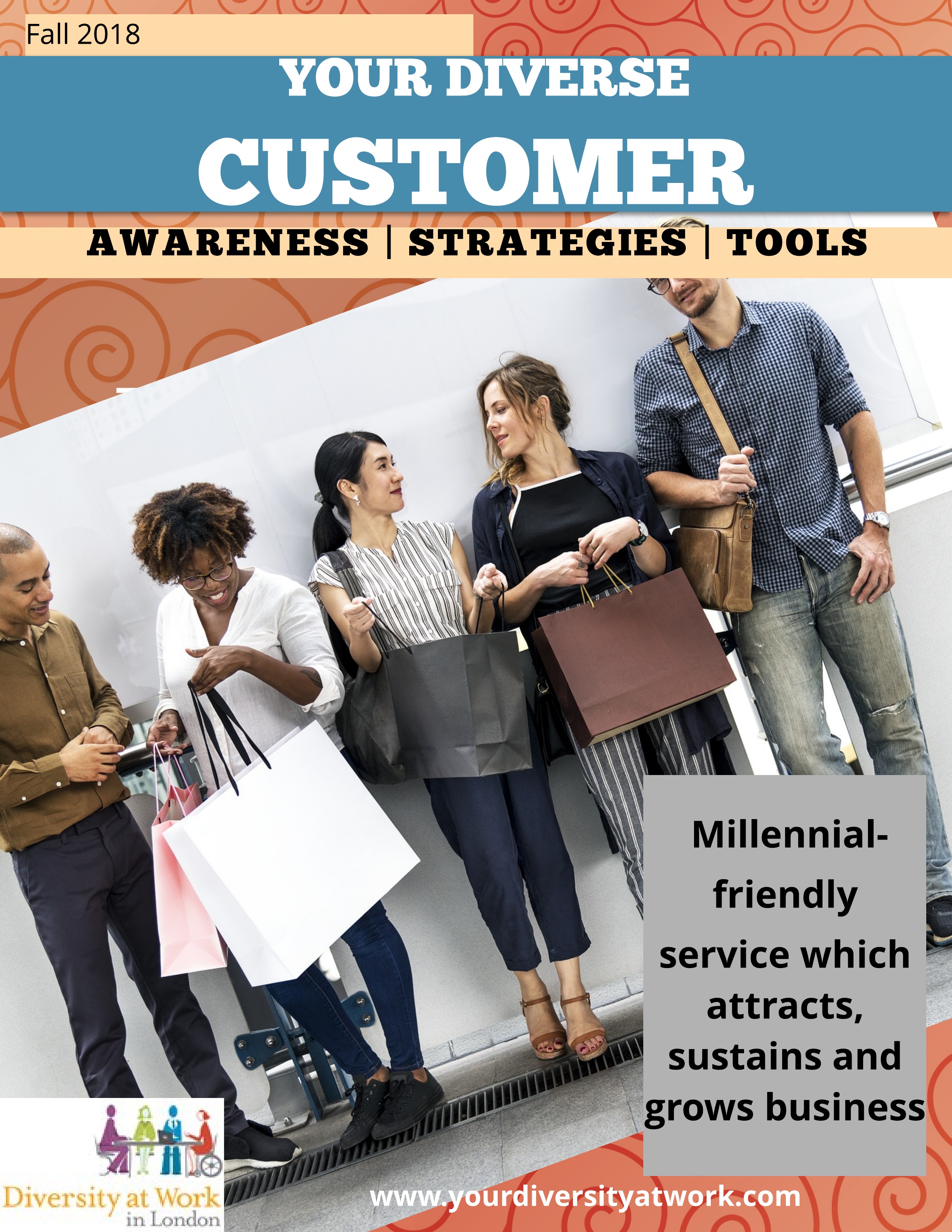
Millennial-Friendly Businesses Which Attract, Sustain and Grow Businesses


If you own a business or youfall 2018 -millennials - cover manage an agency, you will most definitely have Millennials serving your customers /clients. Traditional forms of training are ineffective. Written text is not the way to go! With the multitude of media these days, Millennials expect the training to be engaging, visually-pleasing, authentic and timely.

Remember, they are tech-savvy and lovers of visuals. They value authenticity and timeliness. Corporations like McDonald’s and Avon Canada are catering to this new group of entrepreneurs and workers. By providing online training and scheduling, most of the education process can actually take place in the comfort of the Millennial’s home.

Psychology Professor Christy Price from Dalton State University research concluded, there were 5 R’s to keep in mind.

  1. Research-based methods should be used along with collaboration and no lecturing.
  2. Relevant – information must be timely.
  3. Rationale – they need to know the reason behind the way things are done.
  4. Relaxed – They like laid back sessions with warm and empathetic trainers.
  5. Rapport – They prefer instructors who take a personal interest in them.


To learn more about how to serve, market and train millennials for an excellent customer service experience, purchase this issue of our new training magazine, Your Diverse Customer.

The topics in this issue include:

  • Why is the Millennial market so important?
  • What do Millennials expect when it comes from customer service?
  • Motivating Millennial Employees
  • 5 Different Kinds of Millennials
  • Resources
  • Website Checklist: Is Yours Millennial-Friendly


Your Diverse Customer – Millennial Issue

Pdf version of an eZine

$20.00


Great Customer Service Begins with Knowing How to Work with Language Barriers


coverEvelina Silveira, President, Diversity at Work

Customer service is about communication. A fruitful experience will result in both customer and agent satisfaction. Customer service training implies both the agent and the customer comprehend English, but that is not always the case.

According to Statistics Canada 2016, 2% of the Canadian population cannot speak English or French. The percentage is likely to soar, especially with recent news of mass migration and immigration proposed by the federal government.

Conditional on where you live, or the service you may provide, the percentage of people who lack English proficiency skills may be more substantial. Consider if you are a non-profit agency which delivers employment services to newcomers, or a store located in the heart of an ethnic community? All of these variations may result in a greater need for competencies in working with customer and clients who have language barriers.

While the encounter will be more challenging, it is not unmanageable. You can still provide courteous, attentive and results-oriented customer service. “Going-the-extra-mile” can contribute to customer loyalty; increased brand identification within a community; word-of-mouth advertising; but most of all, the satisfaction of providing them with what they want.

The various strategies and tips we will explore in this issue can be easily adapted to serving customers with learning and cognitive delays. Why? Patience, clear communication, and a willingness to “think-out-side-the-box” are requirements for reaching people with barriers.

In this issue of  Your Diverse Customer Training Ezine, you will learn how to communicate with people who have language barriers.

The contents of this issue include:

  • how to tell the difference between a strong accent and a language barrier
  • guide to reading letters and numbers over the telephone
  • common idioms to avoid
  • 8 Rules for Better Understanding
  • How to Make Your Communication Clearer
  • Case Study
  • Links to Training Resources


Purchase your Pdf version here:

Your Diverse Customer -Serving Customers With Language Barriers

$20.00

  • Sensitivity Empathy Training for Workplace Bullies

  • Enter your email address to follow this blog and receive notifications of new posts by email.

  • Workplace Inclusion and Customer Service Publications

  • Anti-Bullying and Harassment Training for Groups

  • Learn more about our English as a Foreign Language Coaching for Business Success

    Teacher Pointing at Map of World ca. 2002

  • Follow me on Twitter