
Evelina Silveira

A month ago, I had one of my lifetime dreams fulfilled – I visited my parents’ homeland, Flores, Azores, Portugal, along with two other islands, Terceira and São Miguel. It had been almost 50 years since my family’s initial visit.
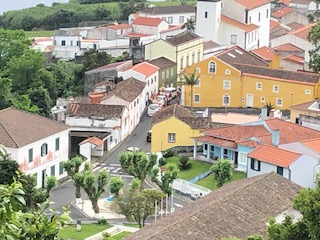
The Azores are a Portuguese autonomous region comprised of nine islands: São Miguel, Terceira, Santa Maria, Faial, Corvo, Flores, São Jorge, Graciosa, and Pico. If you’ve ever wondered what paradise might look like, it probably resembles the Azores.
Growing up, I learned both English and an Azorean dialect, with which I had a basic level of proficiency. However, with the death of my parents, I had no one to practice spoken Portuguese; therefore, I needed to prepare quickly to be able to ask questions and learn about my family history in Portuguese.
Two months in advance, I gave myself a crash course on Portuguese and listened to continental and Azorean news each day to improve my listening skills and enhance my vocabulary. ( It worked amazingly well!)
I was determined to familiarize myself with the etiquette so that I would not come across as “maleducada” or rude. Even though my parents passed away, there is still an expectation to respect their memory by demonstrating that they raised me with good manners. In high context cultures, no matter your age, you are always a symbol and reflection of your family name – it carries you wherever you go.
I had many questions about my parents’ homeland. I wanted to ensure I would be sufficiently fluent to have conversations with locals and connect with some long-lost relatives I had discovered who were still living in Lajedo, Flores. In preparation for the trip, two months beforehand, I spent about two hours daily listening to Telejornal Açores and political podcasts (I love politics, regardless of the language). During that period, I noticed a significant improvement in my listening skills and understanding of various accents, including continental, different Azorean, and Brazilian ones. My vocabulary expanded rapidly. I also added Portuguese documentaries to learn about the country’s history and its nine archipelagos.
Core Traits of Azorean Politeness
As a language coach, a former student of linguistics and a child of Portuguese parents, I know firsthand the importance of understanding and following cultural norms of politeness.
For example, a “maleducado” child would refer to older people using the “tú” pronoun, which would be a terrible embarrassment for parents because they would be seen as not teaching their child proper manners. We were taught never to call adults by their first name, but instead to use the formal “Senhor” (sir) or “Senhora” (Madam). I remember my late mother saying, for instance, “Why don’t her parents correct her? Her aunt is not a ‘tú’ but ‘Tia’ (aunt). This example will often resonate with other multilingual readers.
Greetings
While my sister and I were raised to have polite Portuguese manners, we were not ready for what transpired on our first visit there, when I was 10 and she was 18.
What did two sisters from Canada do in Fajã Grande, Flores (which probably had a population of 300 people then) that led to a scolding from my grandmother when we got home after going for a walk in the village?
A terrible gaffe we will never forget.
We did not say Bom Dia ( Good Morning) when we passed strangers on the street. Little did the villagers know we had been indoctrinated from a young age to not talk to strangers. But, in the Azores, especially in small towns, this is a basic courtesy.
After we calmed our grandmother down, my sister and I vowed to acknowledge every person we saw, whether we were standing out on the veranda, seeing someone cultivate their land or hanging out their clothes to dry. We refused ever to be referred to as “the arrogant American girls who think they are too good to say hello”. Lesson learned.
Fast forward, I prepared my husband (who is not Portuguese) for the trip so he wouldn’t encounter a similar problem. I equipped him with several phrases.
Bom dia,senhor; Desculpe, não falo português. Obrigado . Good Morning, Sir, I don’t speak Portuguese.Thank you.
Consequently, the doors were opened for us immediately, and my husband managed to strike up some conversations with locals who had broken English. Villagers welcomed us to participate in their religious celebrations and invited us to enjoy a communal meal at the church.
Azorean children are taught to be thankful for everything. It may be derived from their own parents’ sense of gratitude for anything that was given to them either through their efforts or with the help of others. Families who had land, crops and livestock would have been considered lucky if they could feed everyone. There were no extras. Reliable electricity and water supply, for example, did not come to my parents’ village until after the late 1970s. Those who had relatives in the diaspora who could send them some money were considered fortunate.

Showing thanks can be done in several ways. While obrigado is the standard, other deviations can be Que Deus te abençoe or May God Bless You, an expression of not only gratitude but also with a religious twist. I heard “muito obrigado” or thank you very much, at a far greater rate than what we hear in Canada, often for what we might consider mundane. On several occasions, I heard Muitissimo obrigado, which would be like an extreme thank you—expressing gratitude ties into the Azorean trait of humility.
Respecting Your Neighbours/Being Quiet
Unlike other Portuguese-speaking cultures, like the Brazilians, Azoreans tend to be more reserved and quieter. Their parties never reach the level of animation and festivity that their South American counterparts enjoy. During the two weeks I spent in the Azores, we took five flights. Many passengers had small children and babies. There were never any people speaking loudly or disturbing others with disruptive devices – that would be unheard of. What a contrast to the flights I had in North America.
While the Azoreans enjoy drinking wine and beer, you’ll find it difficult to spot a loud, obnoxious individual on the street or in a public place. Public displays of intoxication are not funny and are instead vergonhoso or shameful/embarrassing.
Silence is especially golden when it comes to listening to Fado music, Portugal’s national musical treasure. It’s a serious business. Attending a Fado event means being prepared to respect the artist and the form by not speaking or moving around during the performance. Fado is sacred to the Portuguese. The fadista must get into their role, which often requires the belting out of theatrical, soulful and sorrowful lyrics. When the tavern owner declares “Silêncio, que se vai cantar o Fado or “Silence, we are going to sing the Fado,” the audience stops what they are doing and listens. When the outstanding fadista, Jessica Soares, completed her final set at the tavern in Ponta Delgada, she humbly announced, “Thank you for your silences,” which meant, thank you for not speaking during my performance.
Hierarchy
Out of respect, middle-aged people married or otherwise will be conferred the title of “Senhor” or “Senhora”. Growing up, I considered them to be the titles of “old” people. So, you can imagine what it was like for me to be constantly referred to as “Senhora” throughout my whole trip, even though this was the culturally appropriate thing to do. When I realized that “Senhora” had become my badge of honour, I embraced it, and realized I had rightfully earned it. The challenge was that I had to make sure I was respectful and reciprocal with the titles that I used. Each time I opened my mouth to talk to someone unfamiliar, I would have to use “Senhor” or “Senhora” to start the sentence. Since the informal “you” is impolite to use on people of stature or maturity, I had to regularly reset my thought process, replacing “you” with “senhor/senhora”.
Unlike what I am hearing from my Brazilian friend, who has noted that the Portuguese language there is going through some revisions to address its inherent patriarchy. I wouldn’t be holding my breath in the case of the Azores, especially in the most remote islands that have had so little outside influence until recently. When handing the restaurant bill to my husband, the waiter said, “Senhores, posso oferecer algo mais a vocês?” This translates into: “Sirs, can I offer you anything else?” This is a sharp contrast in some restaurant circles where servers are told to leave out the “sirs” or “madams” from their greetings in case they misgender someone.
Polite Insults
Years ago, when I was learning Portuguese to improve my listening skills, I watched telenovelas (soap operas) to help me acquire some basic conversation skills. Just as all soap operas carry drama and insults, Portuguese ones had a special feature – a polite ending. So, you could essentially yell at someone, but when you leave and slam the door, you pull yourself together to say, “Have a good day”. Is this a standard practice? I don’t know for sure, but it seems to happen an awful lot on television programs.
To challenge myself, I listened to the political debates before the Portuguese elections and again, despite the mudslinging, there was always some measure of decorum. For example, you would hear accusations like Com todo respeito, o senhor é um ladrão which translates into, “With all due respect, sir, you are a thief!”.
Nobody’s Perfect
There were so many examples of Azorean politeness and hospitality. One thing that truly shocked us about these seemingly gentle and humble people: how they behave in the driver’s seat. There were moments when I felt like Dennis Weaver’s character in the movie, Duel, about road rage. Imagine having a driver tailgate at a high speed on a very narrow road on a cliff or a decline. Some of these roads are so narrow that you can’t see if a car is coming when you turn, which is why mirrors are positioned on the streets. Many of these old roads were not built for cars but for cows and wagons.
When I commented to my hosts in Terceira that I had not heard anyone swearing, her husband said that I should attend the sporting events and perhaps I would change my mind.
Politeness in the Azores is more than a set of rules. It reflects deep-rooted values as humility, respect, gratitude, and a sense of community. These customs reveal a culture. The subtle reverence of a Fado or the everyday greetings exchanged on village streets, Azoreans esteem connection, dignity, and faith.
Of course, no place is without its twists and surprises. The juxtaposition of tranquil vistas alongside maniacal drivers is one such example. The contrast only adds to the complexity of Azorean life.
I have been shaped by both Canadian and Portuguese worlds. I’ve come to appreciate that cultural etiquette isn’t just about saying the right words. It’s about understanding the affection behind them. And in the Azores, that heart beats with warmth, tradition, and a quiet strength that’s impossible to forget.
Be sure to check out our website, including our on-demand webinars.













 Diversity and Inclusion at Work