
Understanding Azorean Politeness: A Cultural Exploration


Evelina Silveira

shows a hot spring in the Azores

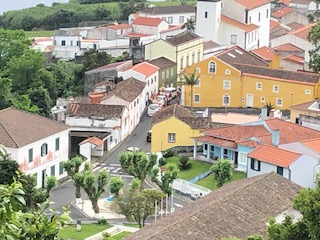
A month ago, I had one of my lifetime dreams fulfilled – I visited my parents’ homeland, Flores, Azores, Portugal, along with two other islands, Terceira and São Miguel.  It had been almost 50 years since my family’s initial visit.

The Azores are a Portuguese autonomous region comprised of nine islands: São Miguel, Terceira, Santa Maria, Faial, Corvo, Flores, São Jorge, Graciosa, and Pico. If you’ve ever wondered what paradise might look like, it probably resembles the Azores.

Growing up, I learned both English and an Azorean dialect, with which I had a basic level of proficiency.  However, with the death of my parents, I had no one to practice spoken Portuguese; therefore, I needed to prepare quickly to be able to ask questions and learn about my family history in Portuguese.

Two months in advance, I gave myself a crash course on Portuguese and listened to continental and Azorean news each day to improve my listening skills and enhance my vocabulary.  ( It worked amazingly well!)

I was determined to familiarize myself with the etiquette so that I would not come across as “maleducada” or rude. Even though my parents passed away, there is still an expectation to respect their memory by demonstrating that they raised me with good manners.  In high context cultures, no matter your age, you are always a symbol and reflection of your family name – it carries you wherever you go.

I had many questions about my parents’ homeland. I wanted to ensure I would be sufficiently fluent to have conversations with locals and connect with some long-lost relatives I had discovered who were still living in Lajedo, Flores. In preparation for the trip, two months beforehand, I spent about two hours daily listening to Telejornal Açores and political podcasts (I love politics, regardless of the language). During that period, I noticed a significant improvement in my listening skills and understanding of various accents, including continental, different Azorean, and Brazilian ones. My vocabulary expanded rapidly. I also added Portuguese documentaries to learn about the country’s history and its nine archipelagos.

 Core Traits of Azorean Politeness

As a language coach, a former student of linguistics and a child of Portuguese parents, I know firsthand the importance of understanding and following cultural norms of politeness.

For example, a “maleducado” child would refer to older people using the “tú” pronoun, which would be a terrible embarrassment for parents because they would be seen as not teaching their child proper manners. We were taught never to call adults by their first name, but instead to use the formal “Senhor” (sir) or “Senhora” (Madam). I remember my late mother saying, for instance, “Why don’t her parents correct her? Her aunt is not a ‘tú’ but ‘Tia’ (aunt). This example will often resonate with other multilingual readers.

 Greetings

While my sister and I were raised to have polite Portuguese manners, we were not ready for what transpired on our first visit there, when I was 10 and she was 18.

What did two sisters from Canada do in Fajã Grande, Flores  (which probably had a population of 300 people then) that led to a scolding from my grandmother when we got home after going for a walk in the village? 

A terrible gaffe we will never forget.

We did not say Bom Dia ( Good Morning) when we passed strangers on the street.  Little did the villagers know we had been indoctrinated from a young age to not talk to strangers.  But, in the Azores, especially in small towns, this is a basic courtesy.

After we calmed our grandmother down, my sister and I vowed to acknowledge every person we saw, whether we were standing out on the veranda, seeing someone cultivate their land or hanging out their clothes to dry.  We refused ever to be referred to as “the arrogant American girls who think they are too good to say hello”. Lesson learned.

 Fast forward, I prepared my husband (who is not Portuguese) for the trip so he wouldn’t encounter a similar problem.  I equipped him with several phrases.

Bom dia,senhor; Desculpe, não falo português. Obrigado  . Good Morning, Sir, I don’t speak Portuguese.Thank you.

Consequently, the doors were opened for us immediately, and my husband managed to strike up some conversations with locals who had broken English.  Villagers welcomed us to participate in their religious celebrations and invited us to enjoy a communal meal at the church.

 Azorean children are taught to be thankful for everything. It may be derived from their own parents’ sense of gratitude for anything that was given to them either through their efforts or with the help of others. Families who had land, crops and livestock would have been considered lucky if they could feed everyone.  There were no extras.  Reliable electricity and water supply, for example, did not come to my parents’ village until after the late 1970s.  Those who had relatives in the diaspora who could send them some money were considered fortunate.

Showing thanks can be done in several ways. While obrigado  is the standard, other deviations can be  Que Deus te abençoe  or  May God Bless You, an expression of not only gratitude but also with a religious twist. I heard “muito obrigado” or thank you very much, at a far greater rate than what we hear in Canada, often for what we might consider mundane.  On several occasions, I heard Muitissimo obrigado, which would be like an extreme thank you—expressing gratitude ties into the Azorean trait of humility.

Respecting Your Neighbours/Being Quiet

Unlike other Portuguese-speaking cultures, like the Brazilians, Azoreans tend to be more reserved and quieter. Their parties never reach the level of animation and festivity that their South American counterparts enjoy. During the two weeks I spent in the Azores, we took five flights. Many passengers had small children and babies. There were never any people speaking loudly or disturbing others with disruptive devices – that would be unheard of. What a contrast to the flights I had in North America.

While the Azoreans enjoy drinking wine and beer, you’ll find it difficult to spot a loud, obnoxious individual on the street or in a public place. Public displays of intoxication are not funny and are instead vergonhoso or shameful/embarrassing.

Silence is especially golden when it comes to listening to Fado music, Portugal’s national musical treasure. It’s a serious business.  Attending a Fado event means being prepared to respect the artist and the form by not speaking or moving around during the performance. Fado is sacred to the Portuguese. The fadista must get into their role, which often requires the belting out of theatrical, soulful and sorrowful lyrics.  When the tavern owner declares “Silêncio, que se vai cantar o Fado or  “Silence, we are going to sing the Fado,” the audience stops what they are doing and listens. When the outstanding fadista, Jessica Soares, completed her final set at the tavern in Ponta Delgada, she humbly announced, “Thank you for your silences,” which meant, thank you for not speaking during my performance.
Hierarchy

Out of respect, middle-aged people married or otherwise will be conferred the title of “Senhor” or “Senhora”. Growing up, I considered them to be the titles of “old” people. So, you can imagine what it was like for me to be constantly referred to as “Senhora” throughout my whole trip, even though this was the culturally appropriate thing to do. When I realized that “Senhora” had become my badge of honour, I embraced it, and realized I had rightfully earned it. The challenge was that I had to make sure I was respectful and reciprocal with the titles that I used. Each time I opened my mouth to talk to someone unfamiliar, I would have to use “Senhor” or “Senhora” to start the sentence.  Since the informal “you” is impolite to use on people of stature or maturity, I had to regularly reset my thought process, replacing “you” with “senhor/senhora”. 

 Unlike what I am hearing from my Brazilian friend, who has noted that the Portuguese language there is going through some revisions to address its inherent patriarchy. I wouldn’t be holding my breath in the case of the Azores, especially in the most remote islands that have had so little outside influence until recently.  When handing the restaurant bill to my husband, the waiter said,  “Senhores, posso oferecer algo mais a vocês?” This translates into: “Sirs, can I offer you anything else?”  This is a sharp contrast in some restaurant circles where servers are told to leave out the “sirs” or “madams” from their greetings in case they misgender someone. 

 Polite Insults

Years ago, when I was learning Portuguese to improve my listening skills, I watched telenovelas (soap operas) to help me acquire some basic conversation skills.  Just as all soap operas carry drama and insults, Portuguese ones had a special feature – a polite ending.  So, you could essentially yell at someone, but when you leave and slam the door, you pull yourself together to say, “Have a good day”. Is this a standard practice?  I don’t know for sure, but it seems to happen an awful lot on television programs.  

To challenge myself, I listened to the political debates before the Portuguese elections and again, despite the mudslinging, there was always some measure of decorum.  For example, you would hear accusations like Com todo respeito, o senhor é um ladrão which translates into, “With all due respect, sir, you are a thief!”.

 Nobody’s Perfect

There were so many examples of Azorean politeness and hospitality. One thing that truly shocked us about these seemingly gentle and humble people: how they behave in the driver’s seat. There were moments when I felt like Dennis Weaver’s character in the movie, Duel, about road rage. Imagine having a driver tailgate at a high speed on a very narrow road on a cliff or a decline. Some of these roads are so narrow that you can’t see if a car is coming when you turn, which is why mirrors are positioned on the streets. Many of these old roads were not built for cars but for cows and wagons.

When I commented to my hosts in Terceira that I had not heard anyone swearing, her husband said that I should attend the sporting events and perhaps I would change my mind.

Politeness in the Azores is more than a set of rules. It reflects deep-rooted values as humility, respect, gratitude, and a sense of community. These customs reveal a culture. The subtle reverence of a Fado or the everyday greetings exchanged on village streets, Azoreans esteem connection, dignity, and faith.

Of course, no place is without its twists and surprises. The juxtaposition of tranquil vistas alongside maniacal drivers is one such example. The contrast only adds to the complexity of Azorean life.

I have been shaped by both Canadian and Portuguese worlds. I’ve come to appreciate that cultural etiquette isn’t just about saying the right words. It’s about understanding the affection behind them. And in the Azores, that heart beats with warmth, tradition, and a quiet strength that’s impossible to forget.


 Be sure to check out our website, including our on-demand webinars.

English as a Second Language in the Workplace: Don’t let it be a barrier to success


By Evelina Silveira

My name is Evelina Silveira; I am TEFL certified, a diversity trainer specializing in intercultural communication, a certified mediator, a trilingual speaker, and the president of my 18- year- old company.

I know that learning a language well enough to conduct business can be a challenge. Your time is precious as an adult, and you want results quickly.

I have worked as an English as a Foreign Language Teacher for over three years with various learners from Asia, South America, Europe and the Middle East. During this time, I have learned about the different struggles various linguistic groups experience.

No matter where English as a Foreign Language speakers reside, they encounter the same issues:

  • Lacking the opportunities to practice speaking English.
  • Completing grammar-intense English classes that did not emphasize speaking skills such as pronunciation or intonation.
  • Adopting non-native English-speaking teachers’ grammatical and pronunciation errors
  • Fossilizing errors
  • Feeling reasonably comfortable with writing but being afraid to speak in public.
  • Lacking the vocabulary and confidence to get their points across

If you have at least a lower intermediate level of understanding of grammar and speaking skills, I can help you to gain the confidence and proficiency you need to advance.

Private, customized sessions are available for individuals. Corporate inquiries are welcome.

All materials are provided. Sessions are delivered on Zoom or on Tencent for clients in China.

Contact evelina@diversityatworkcommunications.com to set up a no-obligation consultation.

Check out our endorsements and learn more

Hurray! It’s Hockey Night in Punjabi!


By:  Evelina Silveira, President Diversity at Work

What is more Canadian than hockey? Maple syrup or poutine? No, not even that!  So what do you get when you add our favourite symbol with a sprinkle of Indo-Pakistani culture? Hockey Night in Canada in Punjabi!

You don’t have to understand Punjabi to appreciate the game. In fact, some of the enjoyment comes from listening to the broadcasters shout out a score.

The elation is magnified in Punjabi!

On the surface, Hockey Night in Punjabi may seem like just a hockey game moderated in another language, but its impact is far-reaching.

It’s a testament to:

  •  the “power of the buck”. It makes for great business. Punjabi is one of the most widely spoken of immigrant languages in Canada. This is a great way to expand the brand and sell! Market segmentation allows for new opportunities for growth.       Whoever thought of this was a genius!


  • from an integration point of view, it shows you can adapt and enjoy cultural aspects of a new country and make them your own.


  •  it tells us sport can bring people together whether you are an Indian-Punjabi speaker or a Pakistani one, cultural differences can be set aside to enjoy the game.

Not unlike the Punjabi spectators, when my parents came to Canada they had never seen a hockey game.  Football (soccer) was their sport of choice back home as ice rinks and snow were no where to be found.  However before long, they discovered the joys of watching Hockey Night in Canada every Saturday.  My mother could enthusiastically rhyme off the names of her favourite team — The Toronto Maple Leafs (this was the  70’s); complete with a Portuguese version of their name.  Before long, each trip to the corner store meant I had a new set of hockey cards with pictures of toothless Darryl Sittler and Eddy Shack!  I never really got into the game on TV, but did not want to break my mother’s heart. I accepted the hockey cards just the same appreciating them for the stick of bubble gum.

Integration into a new culture is not an easy thing to do, but every effort must be made to look at the brighter parts of what it can offer. Hockey Night in Canada in Punjabi tells us while cricket may always be the beloved sport in India and Pakistan, cultural adaptation is possible and necessary.

From a business perspective, it shows us immigrants have spending power and taking a one-size-fits all model may mean missing out on economic opportunities.

So, hurrah for Hockey Night in Canada in Punjabi!  You score on many levels!


Multilingualism: An Essential Ingredient of Culturally Competent Healthcare


Image

By: Evelina Silveira, President, Diversity at Work in London Inc, Publisher, the Inclusion Quarterly

Everyday occurrences and unprocessed feelings usually form the basis of my blogs. Today’s is no different. It is Tuesday, and I am still thinking about the elderly Italian woman I saw over the weekend in a long-term care facility and left wondering: Is there a better way to meet the needs of residents who do not speak English?

I don’t know Rosa (name changed to protect her identity) but I do know that she is Italian as I recognize some of the words she yells or her conversations to imaginary people. No one understands what she is saying and nurses and attendants just continue to speak to her in English, or they ignore her completely because they just don’t know how to communicate with her. Residents will refer to her as “the crazy one” or the “one who is always screaming”. I only know a few words in Italian, but I happened to recall the expression, Che bella ragazza. I decided to look directly at her and say these words to her, checking to see if there was a response. For a moment, she paused as she appeared to hear something familiar and I only had wished I could remember more. I had just referred to her as “a beautiful girl!”  Her face temporary lit up and my heart was warmed. If only, I could have a conversation with her, I thought.

I had to wonder, what was it like for her to be in a home where no one understands her. How frightening to become invisible and voiceless. What a disappointing way to end the remaining years of one’s life.

The need for multilingual staff and volunteers is extremely important in effective healthcare delivery. As more immigrants are entering these facilities, I believe that we could be at a crisis point if we do not do more to address this issue especially in long-term care. Even though the immigrant resident may be fluent in English, for reasons I don’t understand they will often resort back to their mother tongue especially as dementia sets in.

While it may be impossible to have staff who can speak all the languages the residents do, there should be more effort made to provide care to them in their own language.

Here are some recommendations for providing more multilingual services in long-term care.

Employee Recruitment . Research the demographics of your community and include foreign language competencies in job postings based on what you find and on your current service needs.

Libraries and Print Materials. Consider purchasing or asking for donations of multilingual books, periodicals and tapes that residents can enjoy. Add international media.

Foreign Language Training.  There are many low-cost and no-cost ways of learning another language. Conduct a Google search and you’ll find many that are free.

Create a Picture Dictionary With Basic Words and Salutations. These small gestures could go a long way with keeping the resident more stimulated in addition to increasing the competencies of the employees.

We are facing unprecedented changes in healthcare and creating more culturally competent organizations do not have to be costly. Using existing community resources and becoming more innovative in the recruitment, selection and retention of employees can go a long way with developing more inclusive services.


The Bachelor: Language Barrier Is Not An Excuse


Written by: Evelina Silveira, President, Diversity at Work in London Inc.

I hate to admit it, but like 10 million other viewers around the world I became hooked on The Bachelor reality program and saw it for the first time this last season. After a long hard day’s work, watching scenes of beautiful people and places and with absolutely no intellectual demands on my brain – The Bachelor was actually a relaxing way to unwind.

For the last 20 years I have worked with New Canadians so I have grown to learn a lot about second language acquisition. Most of the people who I have worked with would be at the Canadian Language Benchmark of 5 or over so their English is good enough for a survival job – at the very least. For the first few weeks, I was trying to figure out whether the bachelor, Juan Pablo really had a language barrier or were they referring more to his accent. I came to realize that while he might not know all of the slang and idioms like “the little package” he was referring to, but he could not blame his rudeness on his language barrier.

First of all, Juan Pablo has studied in the United States and worked in English television programming,obviously he would have had a very good command of the language. When he spoke he did not make a lot of the usual grammatical mistakes you would expect someone with a language barrier to make. He used articles and pronouns appropriately. Sharleen, the opera singer hit the nail on the head when she said she was looking for someone who was “more cerebral”. She was looking for someone who she could have an intellectual conversation with and it wasn’t him. Juan Pablo did not have a language barrier that prevented him from having an intellectual conversation: he simply lacked depth.

Even with New Canadians with low levels of English like a 5 or lower, they can often make connections, analysis and evaluations of events although with grammatical mistakes. However, if you listen, you can hear the depth of their logic. A language barrier does not make you self-centred. Juan Pablo’s lack of insight and ego-centrism has nothing to do with his language barrier.

He cannot use his language barrier to make excuses for his derogatory comments about gay people and those with cognitive delays. He has lived in the United States long enough to know that these comments are unacceptable.

Furthermore, when his parents said that he was often rude that was very revealing. Although Juan Pablo says he “likes to be honest”, this type of directness is sometimes even too much for North Americans. But according to Edward T. Hall’s theory of high context communication among Latin’s, Juan Pablo’s communication style would be highly inappropriate for a culture that likes to handle conflict in a more indirect way than spelling it out the way he did. I gather his style would not be a big hit among Latin people who are known for their exceptional politeness.

And by the way, Juan Pablo, you cannot blame your language barrier for not knowing how to say: “I love you” or “Will you marry me?” But blame it on something else. Sometimes, “it’s not easy” but it’s not “okay”. I have two pieces of advice for you: seek a therapist and get a thesaurus.

MP900440971[1]

  • Sensitivity Empathy Training for Workplace Bullies

  • Enter your email address to follow this blog and receive notifications of new posts by email.

  • Workplace Inclusion and Customer Service Publications

  • Anti-Bullying and Harassment Training for Groups

  • Learn more about our English as a Foreign Language Coaching for Business Success

    Teacher Pointing at Map of World ca. 2002

  • Follow me on Twitter