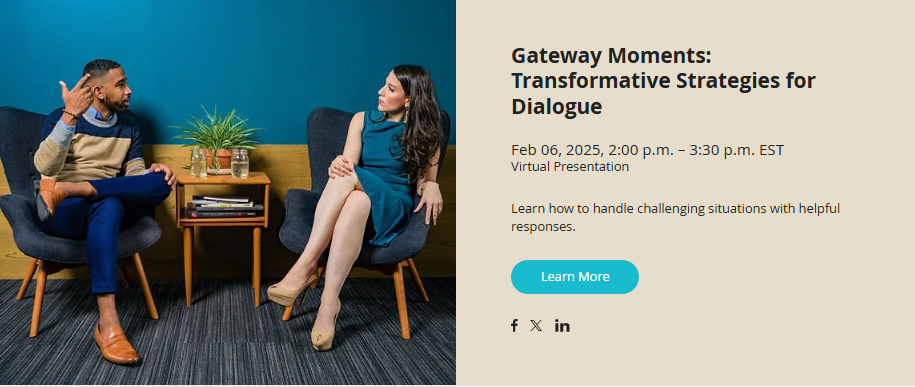
Reduce Workplace Conflicts with Cultural Communication Strategies


Check out professional development opportunities that will enhance your communication skills with co-workers and clients. The full details are here.

A practical, interactive webinar facilitated by a TEFL Certified teacher, experienced diversity trainer and intercultural communication specialist, Evelina Silveira. View the complete outline here.

Do you or an employee struggle to sound professional? Maybe they are too harsh or aggressive. Learn more here.

Reduce conflicts and bias while opening the doors to authentic dialogues. Learn more

To learn more about these webinars, click on the links. Please note registration closes two business days before the scheduled date. Inquire about having this webinar delivered in person or at a time that fits your organization’s schedule. Email evelina@diversityatworkcommunications.com

LEARNING OPPORTUNITIES – Fall 2022


DIVERSITY COMMITTEES: Everything You Wanted to Know

September 9, 2022

Photo by fauxels on Pexels.com

Have you thought about starting a DEI committee but don’t know where to begin? Are you struggling with your current one and wonder what you could do differently? DEI committees can be influential change agents when structured with a purpose and have built-in accountability.

In this webinar, you will learn:

– The benefits of a DEI committee;
– Ways of naming your committee;
– The essential components for a productive and harmonious diversity committee;
– What to include in a Terms of Reference;
– How to  select your  members;
– Troubleshooting common issues;
– Ways to overcome typical challenges;
– How to keep the momentum going;
– About schemes for evaluating your committee.


Learn more.

LANGUAGE BARRIERS: Tips for Inclusive Training

October 5, 2022

Photo by Canva Studio on Pexels.com
Learning the ropes in an organization is tough, but what if you have a language barrier?  You might not get the full benefit of training, compromising your performance and safety.   

That’s why it is incumbent upon trainers to be more creative in their approach and delivery to ensure participants receive equitable opportunities to succeed and contribute to the workplace.

Whether you conduct corporate training, deliver workshops or are training employees 1:1 you will gain new ideas to enhance your training and maximize their learning.

Topics will include:

–  Considerations for culturally sensitive design
–  Strategies for maximizing understanding
–  How to tell if someone has a language barrier
– Tips for making your speaking and writing clearer 
–  Useful tools for building materials that are easier to understand

This is offered in a live-one-hour presentation with opportunities for questions at the end

To learn more, visit.

How to Maximize Your Workplace Diversity: Conduct a Workforce Composition Survey


Introducing the Diversity at Work, Do-It-Yourself Workforce

Composition Survey Toolkit!


workforcesurvey


You would like to know more about your workforce, but you don’t know where to begin.

You’re intimidated by the process.

How do you make sure you ask the right questions?

How can you do this without hiring an expensive consultant?

If you have a skilled human resources team and a secure database — our D-I-Y Workplace Composition Survey Toolkit is for you.

The results will help you to determine:

If your workforce represents the community and clients you serve?

Are you meeting your Employment Equity goals?

Are you fully utilizing the education and training of your workforce?

Do your existing benefit and reward plans fit your current demographics?

What percentage of your workforce will be retiring soon?

Is your workforce representative of the community you work in?

Are you meeting your Employment Equity goals?

Are you fully utilizing the talents of your workforce?

And much more.

Testimonial from user:

“When we first started discussing a Diversity Survey, we didn’t know where to begin with questions and themes, let alone how to ensure the questions we were asking and the message we were delivering was politically correct and relevant to our employees. Evelina and Diversity at Work solved this problem for us by providing a Diversity Survey template, which we were able to modify based on our targeted outcome. This template saved us a tremendous amount of time and money, and also assured us that the survey content was respectful and aligned with our Shared Values.”

Tahlia Rimnyak, CHRP | Human Relations Coordinator
McCormick Canada

For more information and to purchase please visit:

http://www.yourdiversityatwork.com/classes/diyWorkForceSurvey.php


The “Over-Qualified Bias”: What does this mean to employers and candidates?


MP900443225[1]Evelina Silveira, President, Diversity at Work in London,co-author  The No-Nonsense Guide to Workplace Inclusion

The topic of implicit bias has become increasingly popular in diversity and inclusion discussion circles.  Racial, gender, ability, age, cultural and other biases often play a part in deciding whether a  candidate is interviewed, offered, retained and promoted in a job.  Have you ever taken into account that an “over-qualified” label can also have serious ramifications for both your organization and the candidate?

With global unemployment as an epidemic, it naturally makes sense that many applicants may apply for work they have done before, with ease and for an extended period of time.  When these individuals then go to apply for a job which  is similar to what they have done before they are considered “over-qualified” and thus overlooked.  When employers go the “over-qualified” route, they believe that this is a nice way to let applicants down; telling them in a nutshell – “you are too good for this job”.

Next time you consider dismissing an applicant because they are “over-qualified’ it is worth reflecting on the following points:

  1.  The candidate applied for the job and this means they are interested just as any other.
  2.   You may think they are overqualified but they might feel otherwise.
  3.   They may be fine with lateral moves – not everyone wants to climb the corporate ladder.
  4.   They are looking for a less stressful job that they can balance more easily.
  5.   They have outside interests which they may want to devote more energy; and that is why they have chosen to apply for a job which they can perform easily.
  6.   An overqualified candidate can be your best asset. They can bring industry experience which can help your organization soar.
  7.   Do you want to eliminate a candidate from the pool because you fear they will take your job?
  8.   Different people approach work differently. This means that the candidate may find a new way of doing the work that will make it more stimulating and thus more inclined to stay.
  9.   You may be getting more value for their work.
  10.   Over-qualified is a label associated with mature workers. Could you be prejudicing the employment of mature workers?
  11.   Not all over-qualified people demand high salaries which is an assumption that is made all to often.

Before you think a candidate will be “bored in a second and gone in a minute” try some probing questions in the interview to determine whether the risk is high.

  1.   Where do you hope to be in 2 years?
  2.   What are you hoping to learn in this job?
  3.   What motivates you at work?
  4.   What is the ideal job for you?
  5.   What are you looking for in a job?

You may find the job is a perfect match for the candidate you have slotted as “over-qualified”.  There is no guarantee anymore that an employee is going to stay with a company for 10 years.  But realistically, job seekers are not doing a lot of job hopping when there are few options to go to.  If you are concerned their skills are not adequately being used asked them for suggestions.  With work experience under their belt they may make a fantastic mentor which is an exceptionally good way to recognize their value.


CHRR2159-16 HR_readers choice_div-emp-equity

The Guide to Workplace Inclusion


Preview and Purchase at www.yourdiversityatwork.com/ebook/

Read  below what others have said about our book:

linked in

ENDORSEMENTS:

This is an important and timely book for those who want more inclusive workplaces. It moves seamlessly from concepts and terminology and translates them into practical and actionable ideas. All readers, no matter where they are on their diversity and inclusive journey, will find something valuable in this book. Evelina Silveira and Jill Walters have created an impressive resource that includes examples of promising practices from across the globe. This should be every HR professional’s companion!

~Ratna Omidvar, executive director, Global Diversity Exchange, Ted Rogers School of Management, Ryerson University

The No-Nonsense Guide to Workplace Inclusion provides a thorough and engaging roadmap of the journey toward organizational inclusion. The authors write from a position of rich, credible experience, with the result that this Guide can help companies capitalize on opportunities and skirt problems on the road to fuller inclusion of an increasingly diverse workplace. Filled with examples and evidence-based solutions, this Guide is a valuable tool for any organization working on building and strengthening its culture of inclusiveness.

~Alison Konrad, PhD, professor of organizational behaviour, Ivey Business School, London, Canada

Managing diversity and creating inclusive workplaces can seem like a daunting challenge for many organisations, but Evelina and Jill have produced a really accessible, highly practical guide to help organisations get going. What we particularly liked was that it was packed full of real examples and illustrations and lots of useful links and tools.

~Tracy Powley, director, Focal Point Training and Consultancy Ltd, United Kingdom

Because inclusion is one of the core values of the USTA, it is important for me to lead, motivate and work well with individuals of diverse backgrounds, capabilities and interests in order to achieve the outcomes we’ve set for ourselves. This book is a great resource for any organization looking to create a successful culture of inclusion.

~D.A. Abrams, chief diversity & inclusion officer, United States Tennis Association/ author, Diversity & Inclusion: The Big Six Formula for Success

This book goes a long way in addressing the systemic discrimination faced by the LGBTQ2 community in the workplace. It tells you what you need to do and gives you the resources to do it. It makes it easy for any workplace to become more inclusive in their hiring, recruitment and retention practices. I highly recommend it for every workplace.

~ Deb Al-Hamza, past president, Pride London Festival/ diversity social worker, Children’s Aid Society of London & Middlesex

I think this book is very comprehensive! There is very valuable information from ‘Foundations for creating an Inclusive Business Environment’ to ‘Best Practices in Diversity.’ I see the value for small to medium businesses that lack a dedicated human resources professional or lack the experience with implementing policies and procedures to promote an inclusive environment; however, larger businesses can also benefit greatly from the examples, detail and strategy offered. I will continue to visit many of the resources offered in the future and have made note of some of the examples.

~Lesley Oliver, diversity & accessibility coordinator, Equity & Human Rights Services, University of Western Ontario

The book is strategic, concrete and to the point. The various examples make it relevant to readers and practical. I also like the fact it is rooted in personal experiences and takes a holistic approach. The book makes one reflect on what is not obvious, helps avoid assumptions and discusses unconscious bias.

~Magali Toussaint, international career and cross-cultural coach/ diversity professional, Netherlands, http://about.me/magali.toussaint


50% OFF ALL OF OUR PUBLICATIONS FOR THE MONTH OF OCTOBER


fifty-706883_640                   It’s our way of saying thank you for supporting our work!.

Visit our website http://www.yourdiversityatwork.com,  PREVIEW, PURCHASE and DOWNLOAD your copies today!

Accommodating A.D.H.D. in the Workplace


By:  Evelina Silveira, President Diversity at Work in London, co-author No-Nonsense Guide to Workplace Inclusion

Little is known about Adult Attention Deficit Hyperactivity Disorder and it is not well understood. But for those who have this condition, it is the equivalent of experiencing an average person’s number of thoughts in one day all rolled up into two hours! Because one’s mind is so active it can get exhausting and breaks are needed after feeling the rush or flurry of ideas and intense energy boosts. However at the same time, these very active moments are ones in which you could easily solve a problem because you have considered it from many angles or you can design the most amazing piece of work! It has its positive and negative sides; and it is all a matter of perspective. The true test is how both employers and employees can work around it.

How does an employer leverage all of the good qualities associated with A.D.H.D. while trying to diminish some of the less desirable ones? Here are a few hints:

1. Be prepared to offer the employee a quiet place with as little distraction as possible. Hyperactive minds need subdued surroundings for balance. Writing reports, working with numbers etc. can be especially challenging for people with A.D.H.D. because they require a lot of details which involve concentration. Whatever you can do to help eliminate distractions from their work environment will be important. Working at home on some assignments can be a solution for self-disciplined employees.

2. Anticipate that employees with A.D.H.D. will have more breaks during the day. You can negotiate with them about breaking up their lunch hour over the course of the day. Even a few minutes away from their desk every couple of hours can make a big difference in their productivity. Or, they may prefer to work later when everyone has gone home or earlier in the morning when it is quieter.

3. Routine, monotonous work is not meant for these people. It is torture! If the task involves black and white thinking chances are they will be so bored, silly mistakes are more likely to occur. Details are not their strength because they are more big-picture thinkers. Leaving the details to people who like them and are good at them is a better strategy.

4. People with A.D.H.D. tend to like change and are flexible with it because it keeps them more focused and energized. Whether it is changing parts of their job, getting a new one, transitions are preferable rather than problematic. Remember people with A.D.H.D. get bored easily, so whatever you can do to make their work challenging that plays upon their strengths will make it a “win-win” for all. Look for opportunities where they can learn new creative tasks and get involved in work that allows them to put to good use their communication skills. If there is flexibility to move their desks, arrange or re-arrange pictures, filing cabinets etc., let them know. Changing things up every so often makes work feel new. Physically moving furniture gives them a much needed mental break where they can re-energize and re-focus when they return to their desk.

5. Don’t jump to conclusions. For example, just because someone forgets to put their dishes away in the kitchen lunch room isn’t a sign of disrespect or waiting for someone else to do it. They may have completely forgotten and when they remembered it was too late. People with learning disabilities and conditions like A.D.H.D. know that they sometimes “miss the mark” more often than you think. They can feel badly about it because it makes them look inconsiderate. What may come across as sloppiness because of simple errors is usually unintentional. Don’t assume they don’t take pride in their work; they probably did not notice. It is okay to let them know and you may need to keep reminding them to remind themselves. If the report they gave you was proof-read 10 times but each time they read it they did not see the mistakes you did, they are very likely to feel more upset than you. They will feel that they let themselves and you down. You may want to offer them special proof-reading software when applicable or suggest they give the report to another to read before submission.

6. Give as much notice as possible when it comes to deadlines. This gives the employee more opportunity to check their work before submitting it and they can plan their scheduled breaks more easily.

7. Provide the employee with items to help them organize their work. Filing cabinets, post-it notes, and others are good ideas. If you find their time management or organizational skills are bad, suggest some professional development. You may however, be pleasantly surprised to find many people in senior positions with A.D.H.D. who do not have these issues because they have worked on their executive functioning skills to offset some of the challenges associated with A.D.H.D.

8. Don’t make too many excuses. If your employee has a sloppy desk or is regularly forgetting their deadlines, their disability does not excuse them in this case. They have to take responsibility for following the office rules just as anyone.

If you have A.D.H.D and are currently employed, be mindful of the following:

1. Don’t talk too much. People with A.D.H.D. often love to talk but can easily forget they are hoarding the conversation or they are too hyper to listen to someone’s responses. Practice clearing your mind when someone is speaking with you and learn to be a more active listener, otherwise you will come across as self-centred. People with A.D.H.D. at times can display behaviours which isolate themselves from others such as: excessive talking, interrupting, not paying attention and missing social cues. Clearing you mind and active listening is key to building and maintaining friendships and understanding and delivering exceptional customer service.

2. S.T.P. Stop. Think. Predict. Remember, as adults we have to take responsibility for our actions. If you have a tendency to let the hyper part of you dominate, allow yourself to breath and take your time before you make a rushed decision because you are too impatient to wait. Before you hit the “send” button on your nasty email, think about what could be the consequence.

3. Play up your many strengths, which by the way are in big demand these days when it comes to qualifications employers are seeking. Let your talent for communications shine! Be the problem-solver and the empathetic ear to your customer. Demonstrate to your co-workers how well you have learned to multi-task! And most of all don’t be afraid to show your sensitive side.

4. Align yourself with people who are different from you. If you are on a team or you’re a leader, work with people who are detail oriented and they can learn from your big-picture thinking, while they can be your second set of eyes.

5. Organize and make your work as exciting and interesting as possible. In one of my very first jobs as a teenager, I was asked to do frequency counts on different medical procedures. Not an interesting task! I varied the task by using multi-coloured papers and markers. You can do this with highlighter marker, tabs, file-folders etc. Just because your brain seems like a mess sometimes doesn’t mean you have to project it! The only way to keep on task is to be organized. File frequently. Get rid of anything you don’t use on your desk or in your office. It will only be another distraction for you. Go for minimalist – it is also very chic these days!

6. Write down and store any contacts, special dates and deadlines in your calendar as soon as you get them, preventing you from losing them if your desk happens to get too messy or you misplace the paper. Computer back-ups are a great idea.

7. Make templates, checklists and to-do lists. Templates and checklists will help you to be more detail oriented and provide consistency in your work. Prepare a weekly and daily “To-Do-List” and record what you did each day. Doing so, will help you monitor your performance and productivity. Are there patterns you have noticed? What obstacles might be getting in the way of completing your tasks? What can you do about them?

8. Lastly, try not to beat yourself up too much. Some days will seem like all of your faults are on display to the whole world and you just feel embarrassed and want to crawl into a ball. Nobody’s perfect—really! This usually happens to me after I have spent a load of money on printing only to find I missed a typo. Have a short cry, dust yourself off and pick yourself up, because tomorrow you will dazzle with all of the gifts that A.D.H.D. has bestowed upon you!

If you are seeking a speaker on learning disabilities and A.D.H.D in the workplace, please contact Evelina Silveira at evelina@yourdiversityatwork.com. 519-659-4777
  • Sensitivity Empathy Training for Workplace Bullies

  • Enter your email address to follow this blog and receive notifications of new posts by email.

  • Workplace Inclusion and Customer Service Publications

  • Anti-Bullying and Harassment Training for Groups

  • Learn more about our English as a Foreign Language Coaching for Business Success

    Teacher Pointing at Map of World ca. 2002

  • Follow me on Twitter