Reduce Workplace Conflicts with Cultural Communication Strategies


Check out professional development opportunities that will enhance your communication skills with co-workers and clients. The full details are here.

A practical, interactive webinar facilitated by a TEFL Certified teacher, experienced diversity trainer and intercultural communication specialist, Evelina Silveira. View the complete outline here.

Do you or an employee struggle to sound professional? Maybe they are too harsh or aggressive. Learn more here.

Reduce conflicts and bias while opening the doors to authentic dialogues. Learn more

To learn more about these webinars, click on the links. Please note registration closes two business days before the scheduled date. Inquire about having this webinar delivered in person or at a time that fits your organization’s schedule. Email evelina@diversityatworkcommunications.com

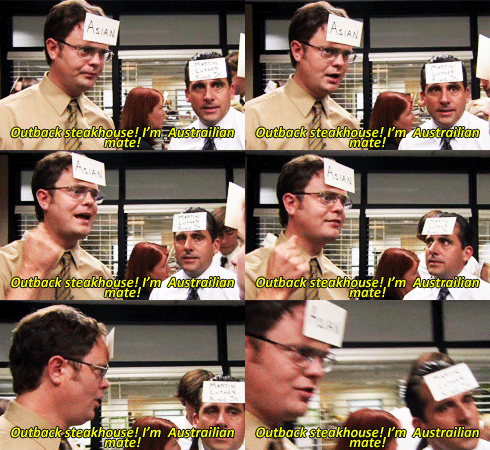
Do You Watch ‘The Office’? My Workshop Gets At The Toughest Communication Grime! (‘Manager Michael Scott’ Needs To Attend!)


the office


I loved The Office. I still watch it in re-runs. It lets me laugh about situations I’ve seen again and again in actual workplaces. It’s not funny in real-life; but it’s hilarious in ‘pretend’!

IN REAL LIFE, I wasn’t laughing when I dealt with:

  • A manager wrongly accused of racism by an under-performer
  • An employee who unintentionally offended a client
  • An outreach worker who wanted to disclose community trends to alleviate a social problem but couldn’t without being falsely labelled herself

Why do these issues arise? Because ‘Awareness Training’ is not enough.

A healthy, safe, fearless workplace requires AUTHENTIC LEADERSHIP. If you are an AUTHENTIC LEADER – or want to become one – then this workshop is for you.

What is an authentic leader? You’re confident, self-aware, and free to be yourself both publicly and privately. You see employees getting mired in political correctness, and the workplace climate being poisoned. You want to do something about it!

COMMUNICATION SKILLS FOR DIVERSE WORKPLACES: My original, 6-HOUR, interactive workshop delivers tools that authentic leaders need to create and support openness and dialogue in the workplace.

In The Office ‘Dunder Mifflin Paper Products’ office and warehouse, people said the wrong things and lived in fear. They walked on eggshells. But they lacked the leadership to behave and communicate more successfully. In one episode, a diversity exercise became a circus of cultural stereotyping! It was funny because it resonates with everyone. Real-life offices face the same issues, but it’s never funny.

As a real-world manager, you experience:

  • Real conversation stifled because of fear of offense or ‘triggering’
  • An increase in bullying and harassment complaints/investigations

PARTICIPANTS IN MY MOST RECENT WORKSHOP (Kitchener-Waterloo YMCA) loved the workshop. In anonymous feedback, participants praised it:

 “I’m more inclined to engage in an uncomfortable dialogue than before this workshop.”

 “I received tools to work through difficult diversity dialogues.”

“Evelina created an atmosphere of openness and allowed uncomfortable conversations.”

“My favorite part was the variety of exercises and sessions.”

“This Communication Skills workshop was well-organized, on-time, and engaging.”

“I really appreciated the openness of Evelina!”

“This workshop was excellent: All the topics related to bias.”

“My favorite parts were the conversations and discussions.”

“I liked how the views and suggestions really support healthy dialogues.”

“I liked group discussions, thought-provoking conversations, and real-life examples.”

Workplaces today are quick to embrace diversity, but good intentions lead to conflict and toxicity. Sondra Thiederman calls this ‘Guerrilla Bias.’ In a workplace that picks up buzzwords, employees learn to identify as victims who are unable to cope with alternate views. No workplace can function and operate properly or effectively in this type of climate.

Authentic Leaders teach Authentic Communication

My workshop equips leaders with the skills necessary for authentic and challenging dialogues. Once in place, differences can be leveraged correctly. Differences become actual benefits, instead of becoming sticks to beat colleagues.

No manager wants their workplace evolving into a real-life version of The Office!

Risk-averse leaders cement a culture of silence. Silence leads to resentment and toxicity, which negates the potential benefits of a diverse workforce! In the wrong environment, diversity becomes a liability instead of an asset.

It doesn’t have to be this way. This is where I come in.

I understand. I hate workplace conflict. Increased calls to my anti-bullying service means workplaces are heating up because workers have stopped talking – they are afraid.

Do you blame them? I don’t.

More and more laws pop up telling us what we can and can’t say. A glance at the media shows how one wrong step, word, or tweet leads to a full-scale social-media attack and demonization.

Again: It doesn’t have to be this way. I can help.

If you want to be an authentic leader, I created my workshop for you and your organization. You’ll learn to be THE LEADER willing to take risks for the greater good of the organization, and to be a POSITIVE-COMMUNICATION MODEL for your team.

The Nitty-Gritty of COMMUNICATION SKILLS FOR DIVERSE WORKPLACES:

  • A highly interactive, 6-hour workshop of my researched, original content
  • Self-reflection exercises for participants
  • Teamwork in small and large groups

But this workshop isn’t for everyone. Why? Because I challenge my participants! You won’t always feel comfortable, but discomfort is where awareness and learning begin.

YOU’LL LEARN:

  • Types of bias, and how personal bias shows up in the workplace
  • Best responses to comments/behaviours you believe are offensive
  • Approaches for justifiable accusations of bias or problematic behaviour
  • How to listen and genuinely understand someone

You’ll emerge with tools and strategies to have AUTHENTIC DIALOGUES, which are the lifeblood of constructive workplace relationships.

 Want to learn more? Interested in creating a GENUINELY authentic, diverse, and inclusive workplace? If you feel you’re an authentic leader, or that you want to learn how to become one, then this workshop is for YOU.

 Contact me to deliver this important workshop to you and your group.

Contact Evelina for more details at: 519-659-4777 evelina@yourdiversityatwork.com


Offense: The Price Of Diversity?


Evelina Silveira, President Diversity at Work

This past year has been particularly challenging for people like me: media/political junkies, who feverishly skim the international news trying to find the truth in a web of misinformation, lies and fake news.  My Twitter newsfeed supplies me with a variety of political viewpoints on diversity issues.  I take all of it in, recognizing that each point may have some validity.  I am open to different points of view and I welcome them.  I especially love factually- based debates.

Why do I like it when people argue about diversity?  Because it means we are part of a free society.

My husband and most of my friends have not lived in democratic countries.  They lived under communism where dissent could not be expressed.  If you have ever heard firsthand the stories of people who feared to say the wrong thing or going against the grain – you would certainly have a better appreciation for how we in the West have been afforded so many freedoms like free speech.

Increasingly, I see freedom of speech is only allowed if you express a certain opinion.  If for example, you go against a liberal opinion there can be severe consequences.

Let’s be very clear before I go any further.  I am not for hate speech — that is very different and our laws seem adequate in that regard. Disagreeing and hate are not the same.

American and Canadian universities have been host to violent protests where audiences thirsting for a  different point of view were hurt.  Campuses were set on fire and a lot of other nasty stuff happened.  You would think that university campuses would be the bastions of free speech and critical thinking? But, apparently not.  What impact does that have on education if what we must always be concerned with not offending others?

I remember sitting through my anthropology classes in university and hearing students rhyme off a very different version of history than the one I was taught. Disparaging remarks were made about believers of my faith and their historically oppressive role.  The professor did not stop the discussion, nor was that the expectation. (Probably these days that would be different.)  I sat and listened to what the student said and decided I would not oppose the remarks. Because the student exchange was deeply emotional for me, it left an imprint.  Decades later, I was able to understand my fellow student’s opinion and would agree with her in part and glad the professor did not shut down the conversation because she was concerned it “would offend someone”.

One of the ways I like to set myself apart from other practitioners is that I encourage the free flow of discussion about various diversity issues from a number of sources which is reflected in my Twitter and Facebook presence.  It reminds me of when teachers would explain that you should use a number of sources to substantiate your argument and present both sides.  That’s a really honest approach – and one I support.

Unfortunately, I have found that my need to present a diversity of opinions is not always met very well on social media.  And despite having a private business, some Tweeters feel that I should stick to the same predictable perspectives on issues all of the time.  For me, if I only present one side of an argument I am just another agent of propaganda.  I also feel that I am insulting my followers/ readers believing that they are not entitled to other views and can make their own decisions.  Diversity for me also spells diversity of ideas and opinions.

What I do know is that the lines between expressing a different point of view and hate speech are becoming frightfully blurred.  The best way to shut down a dissenting argument is to say it is “hateful” or “offensive”. Calling someone a racist in Western society is one of the worst accusations and is hurled left, right and centre at people who are often expressing a different view which has nothing to do with hate.

Diversity, free speech, and offense go hand in hand.  If we are going to be a welcoming society to a diversity of people, their values, and beliefs we all need to make peace with the fact that at times we will be challenged and that can be very emotional.  We cannot legislate hurt feelings or thoughts so why are we even trying?  We either grow a tougher skin or live in an Orwellian thought-controlled society:  what would you prefer?


Evelina, Dog Owner. Why Labels Suck.


Evelina Silveira, President, Diversity at Work

I usually like to start my day off with reading news stories from around the world, hoping to capture a balanced view of what is actually happening.  It is not always so easy to piece it all together.   One thing stands out for me for sure. The presence of labels: when, how and if they are used to describe protagonists and antagonists in the stories.

We are uncomfortable with applying specific labels when we see large groups  doing nasty things.  You are more likely to see an avoidance  of labels  with Canadian television broadcasters or more socially oriented European media.   The concern is about stereotyping, backlash, and creating fear.  On the opposite side of the spectrum when the media, social movements, governments and others want to draw negative attention to a group – the labeling comes in really handy.

Sampson 015 (1)

My Twitter feed was laden with sexist and racist exposés from journalists covering the Olympics in Rio. I also read about the hateful interactions of Arab athletes against the Israelis.  Clearly, “Israeli” or “Jew” a divisive label, was preferred over a more conciliatory one of  “fellow-athlete”.   How sad!

Labeling is tricky.  Gabby Douglas, the American Gold Gymnast had her share of labels thrown at her during the Olympics.  A lot of them weren’t very nice.  It was interesting to note how Gabby’s “blackness” was plastered around Twitter by black groups.  Then to my surprise, I saw again in my feed an article about how Gabby Douglas credits her Jewish upbringing with helping her to succeed.  Two cultural/racial groups wanting to make her their own and confer their label as a celebration of membership.  For individuals who judge people on one-dimensional characteristics: where does someone like Gabby fit in?   Since she is Jewish, does that mean she fits into the white privileged category that oppression activists would categorize, even though hatred against Jews is now considered to have reached the levels of pre-Second World War times? Or is she black?  Here lies the problem with looking at human beings so simplistically.  We are not one-dimensional.   It is time to reconsider the limitations of dangerously divisive thinking.

Labeling has been on my mind for a while, and more so now as I connect with Americans. My race seems to always come up.    Along with that, it becomes important for them to tell me their race when we are speaking over the phone.  I don’t understand it, maybe I will in the future.  In my opinion it is irrelevant, and so I wish my race was too.  I don’t think there is a universal “white” or “black” way of thinking.

I am Evelina: a multi-dimensional human being and so are you.  If it makes you happy to label me, why don’t you categorize me as  Evelina,  dog owner? I much prefer that.


What the Brits’ Telly Can Teach Us About Diversity Dialogues


tv

Evelina Silveira,  President, Diversity at Work

When you think about British television, what comes to mind?  Well, if you are not British most of us would probably say Coronation Street  because it has been around forever on Canadian televisions. But there is so much more to discover!  Deciding to join the cable cutting crowd, I have opted for YouTube instead, for my nightly viewing. And British TV is it!

I have been so impressed with the wide range of British television programs devoted to social experiments in the form of reality TV.  To their credit, it appears the Brits are sincerely trying to understand “the other” through their programs of cultural exchanges of various sorts.  They’re not your regular run-of-the-mill low budget reality programs but thoughtful, out-of-the-box productions that are not afraid to ask the tough questions.

Why do I find the programs to be so remarkable?  Because the participants in the social experiments get a chance to “walk in the other person’s shoes” and freely ask questions without being afraid of a label of “homophobe”, “racist”, “islamaphone” “xenophobe” etc.  You get to see the good, the bad and the ugly.  Nothing is held back and I like that.  At least, when everyone has their preconceptions on the table you have something to work with instead being terminally superficial and polite.

What I began to notice in British television was delightfully refreshing.  The Brits actually engage others in a conversation about diversity.   I don’t see that happening in Canadian television.  All  we ever see is one side of a story and you either accept it or you don’t.  There is rarely an opportunity for two groups to come together and learn about one another and gain sensitivity, empathy and insight into the other group’s world.  The Brits seem to love programs devoted to “social experiments” and I have to tell you as a lover of sociology and anthropology — these types of programs score high for me.

It must have been a television genius who came up with the subject matter.  I have watched at least one  episode with the following themes:

  • A small group of Brits who have to live like a Muslim for a designated period of time.
  • Six men from a variety of backgrounds and lifestyles who go to live in a Benedictine monastery and must follow their rules
  • Nasty British teenagers who are sent to live with an American Amish family to help them reform their ways
  • Bad behaving British teenagers who are sent to live with another family in a foreign country which is known to be “very strict”
  • Several English citizens who feel they have been negatively impacted by immigration are matched with immigrants to challenge some of their assumptions

What so good about these experiments? What do participants often learn from the experience?

  • There is greater understanding that can come from honest and often challenging conversations. You might either become stronger in your conviction or  more empathetic to the other’s experience.
  • There is value and meaning in learning about other people’s rituals even if they seem far off.
  • We can be enriched by others’ experiences and might find adopting aspects of their lives to our own.
  • Having your assumptions challenged is not a bad thing and it contributes to your own personal growth.  You can also help others grow by letting them express their biases/stereotypes and prejudices and work with them.
  • You can’t live in a liberal democracy without expecting to be offended occasionally: a price of freedom of expression.

For example, in the BBC documentary a young British-born  worker is matched to a Polish immigrant who owns his own construction business.  The young man contends foreigners are taking all of the jobs.  He gets to meet Mariuscz  a business owner and notices that his whole shop is full of only Polish workers which fuels his negative perception.   However, when he has a conversation with Mariuscz he realizes that these workers have a starting wage which is much lower than he would accept.  Mariuscz says he started at a low salary and worked his way up in a shop and finally decided to open his own business.  Mariuscz however is challenged to see that hiring only Polish workers is discriminatory and that he could benefit from English-speaking employees.  He is open to accepting this criticism and comes to see that his workers would learn English if there was someone around who would be prepared to speak it.  The result of this dialogue?  I would say a win-win for both participants.  Each was open to hearing the other’s point of view and challenge their own thinking.

British television shows me how much we Canadians have in common  However, I would have to say a few programs that I watched momentarily would never survive in Canada.  They are just too mean! Programs like Fat Families and Life on the DoleLife on the Dole  does not seem balanced at all.  Most of the cast consists of drug addicts, people who don’t want to work and ex-cons.  We don’t see many examples of the working poor.  If the purpose of Life on the Dole  is to make working people angry about the poor, than it succeeds in that regard.  If this program was filmed in Canada the slant would be different.  It would be aired to bring about empathy and awareness of the poor and set in a more compassionate light and with less of a classist tone.

All in all, British television rocks!  I need to run —-  Wife Swap UK is on!


Quick and Easy Ideas for LGBT Workplace Inclusion


Image

Evelina Silveira, President, Diversity at Work in London Inc.  Author, Diversity and Inclusion on a Budget:  How to have a more engaged and innovative workforce with little or no dollars.

Pride Month is coming up and now is the time to take a look at what your organization is doing to create workplace inclusion for lesbian, gay, bi-sexual, and transgendered employees.  Even though I am a big supporter of LGBT inclusion in the workplace and in the community at large, sometimes I find myself stumped at what can we do in our organizations to advance the cause?  I figured that there were other people out there who likely feel how I do, but don’t know where to begin.  I did some research and I came up with a few ideas below that are really quite easy to do.  You don’t have to have a big budget, but you will see that these ideas will no doubt contribute to a more caring, engaged and productive workplace.

  • Don’t assume everyone is straight.
  • Remember to communicate a zero tolerance policy that inappropriate comments or jokes will not be allowed.
  • Keep in mind that LGBT employees often have children, spouses and partners. Show interest in their lives as well.
  • “Coming–out” is usually a risky thing to do in the workplace. When someone shares this with you, thank them for their trust in you and honour their need for privacy.
  • Convey verbally and in writing that professional development and promotional opportunities are solely based on merit.
  • When you are embarking on diversity and workplace inclusion training remember to include LGBT content.
  • Include any policies or benefits to LGBT employees on your website as you would for other groups. In the case of a global operation, it is important to let employees know how LGBT company practices and societal approaches abroad may be different if a transfer or travel is involved.
  • Don’t overlook LGBT causes when you are looking for outreach opportunities in your community. Considering the prevalence of bullying and higher levels of suicide among LGBT youth, these groups could use more resources.
  • Send out a Happy Pride Month message in your newsletter, intranet or other form of communication, just as you would with any other special month.
  • Ask employees if they have any ideas to improve LGBT inclusion in the workplace or marketing/customer service efforts to this population. These questions should be posed to your employees in general and not singling out LGBT in your organization.


If you would like more easy and low-cost ways to make your workplace more inclusive, consider purchasing our eBook, Diversity and Inclusion on a Budget  at http://www.yourdiversityatwork.com/ebook/ .


The Bachelor: Language Barrier Is Not An Excuse


Written by: Evelina Silveira, President, Diversity at Work in London Inc.

I hate to admit it, but like 10 million other viewers around the world I became hooked on The Bachelor reality program and saw it for the first time this last season. After a long hard day’s work, watching scenes of beautiful people and places and with absolutely no intellectual demands on my brain – The Bachelor was actually a relaxing way to unwind.

For the last 20 years I have worked with New Canadians so I have grown to learn a lot about second language acquisition. Most of the people who I have worked with would be at the Canadian Language Benchmark of 5 or over so their English is good enough for a survival job – at the very least. For the first few weeks, I was trying to figure out whether the bachelor, Juan Pablo really had a language barrier or were they referring more to his accent. I came to realize that while he might not know all of the slang and idioms like “the little package” he was referring to, but he could not blame his rudeness on his language barrier.

First of all, Juan Pablo has studied in the United States and worked in English television programming,obviously he would have had a very good command of the language. When he spoke he did not make a lot of the usual grammatical mistakes you would expect someone with a language barrier to make. He used articles and pronouns appropriately. Sharleen, the opera singer hit the nail on the head when she said she was looking for someone who was “more cerebral”. She was looking for someone who she could have an intellectual conversation with and it wasn’t him. Juan Pablo did not have a language barrier that prevented him from having an intellectual conversation: he simply lacked depth.

Even with New Canadians with low levels of English like a 5 or lower, they can often make connections, analysis and evaluations of events although with grammatical mistakes. However, if you listen, you can hear the depth of their logic. A language barrier does not make you self-centred. Juan Pablo’s lack of insight and ego-centrism has nothing to do with his language barrier.

He cannot use his language barrier to make excuses for his derogatory comments about gay people and those with cognitive delays. He has lived in the United States long enough to know that these comments are unacceptable.

Furthermore, when his parents said that he was often rude that was very revealing. Although Juan Pablo says he “likes to be honest”, this type of directness is sometimes even too much for North Americans. But according to Edward T. Hall’s theory of high context communication among Latin’s, Juan Pablo’s communication style would be highly inappropriate for a culture that likes to handle conflict in a more indirect way than spelling it out the way he did. I gather his style would not be a big hit among Latin people who are known for their exceptional politeness.

And by the way, Juan Pablo, you cannot blame your language barrier for not knowing how to say: “I love you” or “Will you marry me?” But blame it on something else. Sometimes, “it’s not easy” but it’s not “okay”. I have two pieces of advice for you: seek a therapist and get a thesaurus.

MP900440971[1]

Stand Up Against the “B” Word


ImageSo it is summer, and things have slowed down and now I have time to do things like watch television.  It seems like it has been awhile since I have watched so much television, but I am going to put a halt to it very soon.   I cannot believe what I am seeing!  Has the world become so numb and accepting of the violence against women in TV?  Reality television has stooped to the lowest level when a bunch of women are vying for a bachelor? Roma women are punching each other and slapping the face of a pregnant woman?  Vancouver beauties fight over who has more filler or botox? And on top of that the “Bitch” word and “Slut” word gets furiously hurled around like it was nothing, even in daytime programming which was once supposed to have higher decency standards!

Since when did it become acceptable and common place to call women female dogs?  I don’t care if some women have reclaimed this word as their own.  The connotation is still negative.  We are ascribing half of the world’s population to the status of an animal.  Why are anti-racist activists so good at challenging the use of derogatory and racist words and women are not?  Is it that women are unsuccessful with challenging it, or are their calls not being heard? When was the last time you saw the “N” word written if full?  You probably haven’t.  The “N” word has become so repugnant in our vocabulary that the mere sight of it, makes a lot of people enraged.  It’s meaning heralds back to a time of slavery, inequality, and the inferior role that black people had in our society.

I wish that we could do the same with the “B” word or the “S” word and others  What will it take for us to see that calling women these words is repugnant as well? It seems that we haven’t really progressed that much. By using these words, we show that we are backward and that women have not reached the same equal status as men in our society.  We still judge them on their submission, passivity, and on their sexual history.

Let’s challenge one another when we use these words against women.  One by one we can make these misogynistic words cast outs from our vernacular.  It is going to take some time but  high time that women enjoyed equal status in this society, don’t you think?

  • Sensitivity Empathy Training for Workplace Bullies

  • Enter your email address to follow this blog and receive notifications of new posts by email.

  • Workplace Inclusion and Customer Service Publications

  • Anti-Bullying and Harassment Training for Groups

  • Learn more about our English as a Foreign Language Coaching for Business Success

    Teacher Pointing at Map of World ca. 2002

  • Follow me on Twitter