How to Maximize Your Workplace Diversity: Conduct a Workforce Composition Survey


Introducing the Diversity at Work, Do-It-Yourself Workforce

Composition Survey Toolkit!


workforcesurvey


You would like to know more about your workforce, but you don’t know where to begin.

You’re intimidated by the process.

How do you make sure you ask the right questions?

How can you do this without hiring an expensive consultant?

If you have a skilled human resources team and a secure database — our D-I-Y Workplace Composition Survey Toolkit is for you.

The results will help you to determine:

If your workforce represents the community and clients you serve?

Are you meeting your Employment Equity goals?

Are you fully utilizing the education and training of your workforce?

Do your existing benefit and reward plans fit your current demographics?

What percentage of your workforce will be retiring soon?

Is your workforce representative of the community you work in?

Are you meeting your Employment Equity goals?

Are you fully utilizing the talents of your workforce?

And much more.

Testimonial from user:

“When we first started discussing a Diversity Survey, we didn’t know where to begin with questions and themes, let alone how to ensure the questions we were asking and the message we were delivering was politically correct and relevant to our employees. Evelina and Diversity at Work solved this problem for us by providing a Diversity Survey template, which we were able to modify based on our targeted outcome. This template saved us a tremendous amount of time and money, and also assured us that the survey content was respectful and aligned with our Shared Values.”

Tahlia Rimnyak, CHRP | Human Relations Coordinator
McCormick Canada

For more information and to purchase please visit:

http://www.yourdiversityatwork.com/classes/diyWorkForceSurvey.php


London’s Poor Diversity Score No Surprise


Written by: Evelina Silveira, President Diversity at Work

As featured in New Canadian Media
Thursday, 27 October 2016 

A recent study published by the Western University’s Centre for Research on Migration and Ethnic Relations found a severe lack of visible minorities in leadership roles in organizations in London, Ontario. 

While the study made headlines, the findings came as no surprise to me.  I have lived in London all my life, working as a diversity consultant for 10 years. I would like to offer an explanation as to why inroads have not been made in visible minority leadership in  London, Ontario.

Flashback to about 13 years ago, when I started to work on a business plan for Diversity at Work: I interviewed many leaders in London asking them whether my idea of having a business which promoted hiring and supporting diverse candidates would ever fly?

I will never forget the answer I received from a human resources consultant who had previously held many jobs in the recruitment and leadership fields.  She said:  “Evelina, as long as there are enough white people to fill the jobs, no one will ever consider anyone else, because they don’t have to.”

Essentially, she conveyed that there really was no need to change the recruitment process and that it was too much work to do so.

A late joiner

In comparison to other cities, London has lagged behind. Perhaps it is because the jobs could easily be filled as the human resources consultant suggested, or maybe we ignore the ever-growing presence of visible minorities which started in the mid-1980’s. 

Some of our largest employers and institutions have only recently developed diversity policies, later than their counterparts in other comparable cities which have a high number of visible minorities and immigrants. I often scan the diversity plans of the public service organizations in London and it would appear that the effort or the kind of approach being used – if at all – are not producing  much in terms of achieving a representative workforce, let alone diversity in leadership. 

My observations are consistent with the findings which indicate a very low level of visible minority participation, notably 5.3 per cent on agencies, boards, and commissions.  Their lack of participation at these levels can have ramifications for how services are delivered, in addition to resource allocation. 

Furthermore, there is a tendency, especially with boards, to recruit people they know, often friends and co-workers, to fill vacancies.  This can perpetuate the lack of representation and the effort to create more diversified boards and committees.

It is startling how many workplaces have not implemented the strategies and best practices that can help mitigate these gaps. How might we explain the disconnect? There is a multitude of reasons why this occurs and this is key to understanding the problem of under-representation in London’s publicly-funded organizations.

Consider these possibilities:

·         Foreign credentials and work experience are not recognized. Generally speaking, if an applicant has not graduated from a leadership program in North America or the U.K , there is a good chance their education in leadership may not be recognized.  Leadership experience from other  parts of the world may not be taken into consideration for a host of reasons, including cultural differences in how we do business and interact with employees.  

·         Effective leadership requires highly developed communication skills:  in person, in writing and over the phone.  An internationally-trained applicant is disadvantaged if they have a pronounced accent and have an indirect style of communication.  Interviewer bias can hamper heavily-accented applicants, who may be mistaken as unqualified because they speak differently.  Across cultures, there are variations in how we conduct meetings, presentations and write reports. The Canadian standards are often learned in school or through work experience.

At civic level: zero

The number of visible minorities and immigrant leaders in municipal organizations is at a glaring zero per cent! 

Given that government organizations are held to a higher standard than the private sector to have a reflective workforce, as well as to meet Employment Equity standards, this represents a failure of implementation and consequently lost opportunities for diversifying the workforce and gaining new skills and perspectives. 

With increasing job insecurity, good benefits and salaries, public service employees are not likely to leave their jobs.  Understandably, this represents fewer opportunities for external applicants to get hired. 

It would be interesting to know if the City of London has an internal mentoring program to assist aspiring leaders.  Research consistently indicates that visible minorities and immigrants find a lack of mentors in the workplace. 

Successful leaders often attest to the significance of mentors throughout their careers.  There have been some attempts over the last few years to develop internships for immigrant professionals at the City of London. However, it is hard to know if this experience translated into permanent employment with the City.

Finally, we cannot overlook bias and racism in the recruitment and selection process, although it does not probably explain the huge disconnect between the population and their representation in the workforce. In my experience, if the leadership in an organization is not familiar with the business benefits of a diverse workforce, they are very unlikely to support and initiate programs which can facilitate the entry and promotion of visible minorities within their organizations.

Evelina Silveira is the President of Diversity at Work in London, a three-time award -winning firm which specializes in creating inclusive workplaces and diverse customer bases.  She has co-authored two globally acclaimed books and is the publisher of the Inclusion Quarterly.
Coaching New Canadians in Soft Skills: How do you do it?


Evelina Silveira, President, Diversity at Work in London Inc.

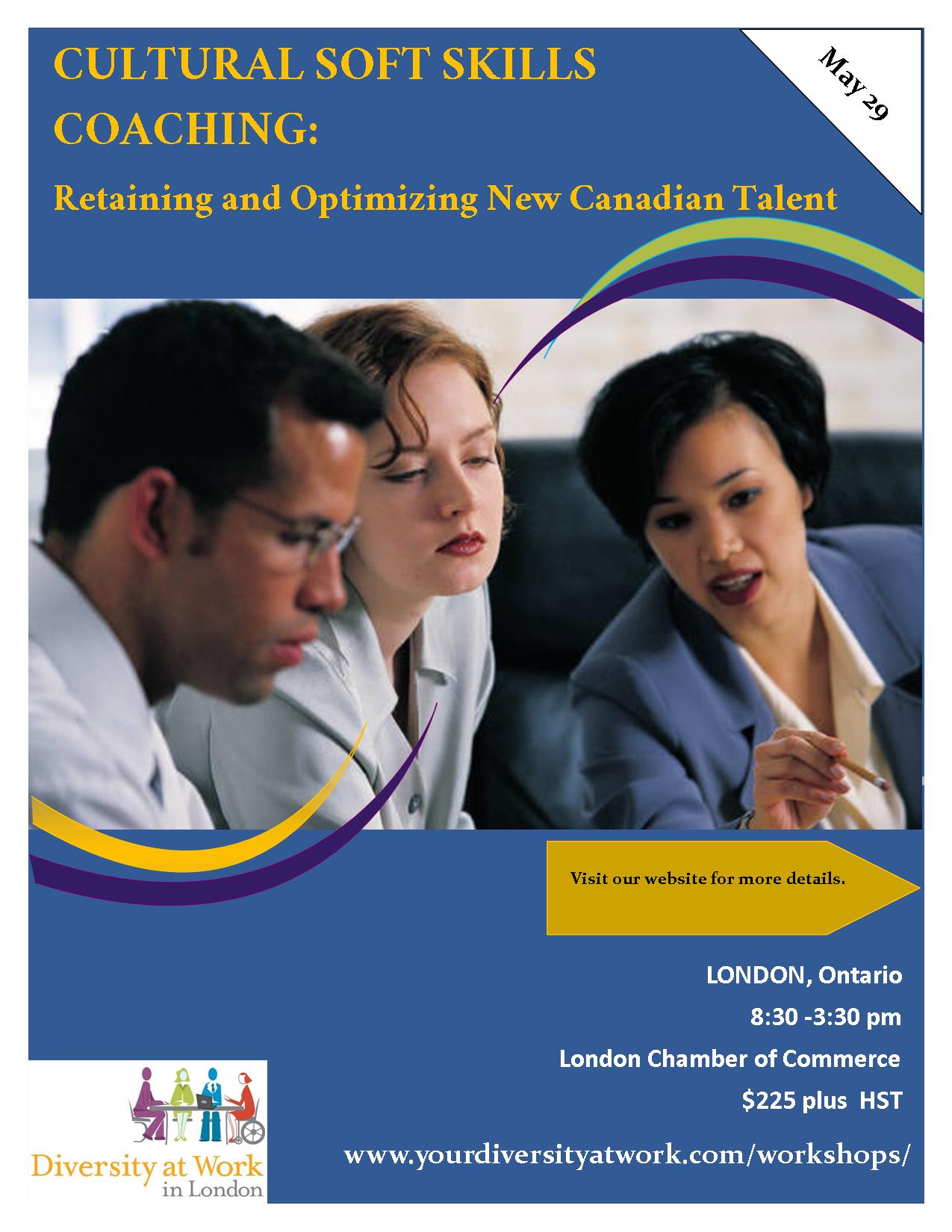
I am pleased to announce an upcoming workshop that I will be doing in London, Ontario on May 29th. It combines what I have learned over the years in: international education, coaching and mentoring New Canadians in the workplace and working directly with employers regarding their integration. If you are interested in learning how to optimize and retain immigrant talent, this workshop is for you. If you cannot make the workshop in London, we are happy to deliver it to your workplace or community. We travel anywhere, just ask.   For full details, visit our website at http://www.yourdiversityatwork.com/workshops/.

coaching

Five Easy Actions for a More Inclusive Workplace


Evelina Silveira, President, Diversity at Work  co-author  No-Nonsense Guide to Workplace Inclusion

Workplace inclusion can seem like an elusive goal. Does it really have to be that way? Whether you have a strategy in place, or take small steps with bolder ones along the way—it will pay off! Here are a few ideas, they don’t take a lot of effort and best of all you can start them today!

1. Add a voluntary self-identification check box in your application process.

Who’s applying? Who is not? Self-identification will provide you with vital statistics for human resources planning. Case in point: if you start to see a pattern that only men are applying for a job, barriers could exist for women. This is worth investigating. Organizations are increasingly expected to reflect the communities they serve. Voluntary self-identification is one way of obtaining this information from the front end. Be sure to outline why you are requesting the information and how it will be used.

2. Add a diversity and inclusion section to each of your staff /leadership meetings.

Injecting awareness and instructional information into your workplace on a regular basis is a significant reminder, diversity and inclusion is an integral part of your operations. It is not an add-on but just as crucial as health and safety awareness.

3. Ask your generation Y (Millennials) for their opinion.

Seems strange? Not really! They are dying to hear from you. These workers have had diversity as a natural part of their landscape. They have expertise and want to be acknowledged for their opinions. Find out what they think you could do to make the workplace better and ask them to help out with building a strategy.

4. Thank an employee.

Each week send a handwritten thank you note to an employee recognizing their work. How long does it take? The busiest person on the planet has two minutes to thank an employee. Isn’t a good employee worth the time? Your recognition will go a long way with boosting morale.
5. Inform all staff about professional development and promotional opportunities.

You are probably thinking we do that already so what’s the big deal? Consistently, research points to the fact that visible minorities, women and immigrants are often left out of the loop when it comes to growing and developing in the organization. Workplace equity begins with giving everyone the same information and organizational opportunities.

Motivated to learn more about workplace inclusion? The No-Nonsense Guide to Workplace Inclusion can show you how to do it. Endorsed by business management schools and diversity practitioners, it’s all you really need.  Visit http://www.yourdiversityatwork.com/ebook/  to preview and purchase.

Stand Up Against the “B” Word


ImageSo it is summer, and things have slowed down and now I have time to do things like watch television.  It seems like it has been awhile since I have watched so much television, but I am going to put a halt to it very soon.   I cannot believe what I am seeing!  Has the world become so numb and accepting of the violence against women in TV?  Reality television has stooped to the lowest level when a bunch of women are vying for a bachelor? Roma women are punching each other and slapping the face of a pregnant woman?  Vancouver beauties fight over who has more filler or botox? And on top of that the “Bitch” word and “Slut” word gets furiously hurled around like it was nothing, even in daytime programming which was once supposed to have higher decency standards!

Since when did it become acceptable and common place to call women female dogs?  I don’t care if some women have reclaimed this word as their own.  The connotation is still negative.  We are ascribing half of the world’s population to the status of an animal.  Why are anti-racist activists so good at challenging the use of derogatory and racist words and women are not?  Is it that women are unsuccessful with challenging it, or are their calls not being heard? When was the last time you saw the “N” word written if full?  You probably haven’t.  The “N” word has become so repugnant in our vocabulary that the mere sight of it, makes a lot of people enraged.  It’s meaning heralds back to a time of slavery, inequality, and the inferior role that black people had in our society.

I wish that we could do the same with the “B” word or the “S” word and others  What will it take for us to see that calling women these words is repugnant as well? It seems that we haven’t really progressed that much. By using these words, we show that we are backward and that women have not reached the same equal status as men in our society.  We still judge them on their submission, passivity, and on their sexual history.

Let’s challenge one another when we use these words against women.  One by one we can make these misogynistic words cast outs from our vernacular.  It is going to take some time but  high time that women enjoyed equal status in this society, don’t you think?

  • Sensitivity Empathy Training for Workplace Bullies

  • Enter your email address to follow this blog and receive notifications of new posts by email.

  • Workplace Inclusion and Customer Service Publications

  • Anti-Bullying and Harassment Training for Groups

  • Learn more about our English as a Foreign Language Coaching for Business Success

    Teacher Pointing at Map of World ca. 2002

  • Follow me on Twitter