Coaching New Canadians in Soft Skills: How do you do it?


Evelina Silveira, President, Diversity at Work in London Inc.

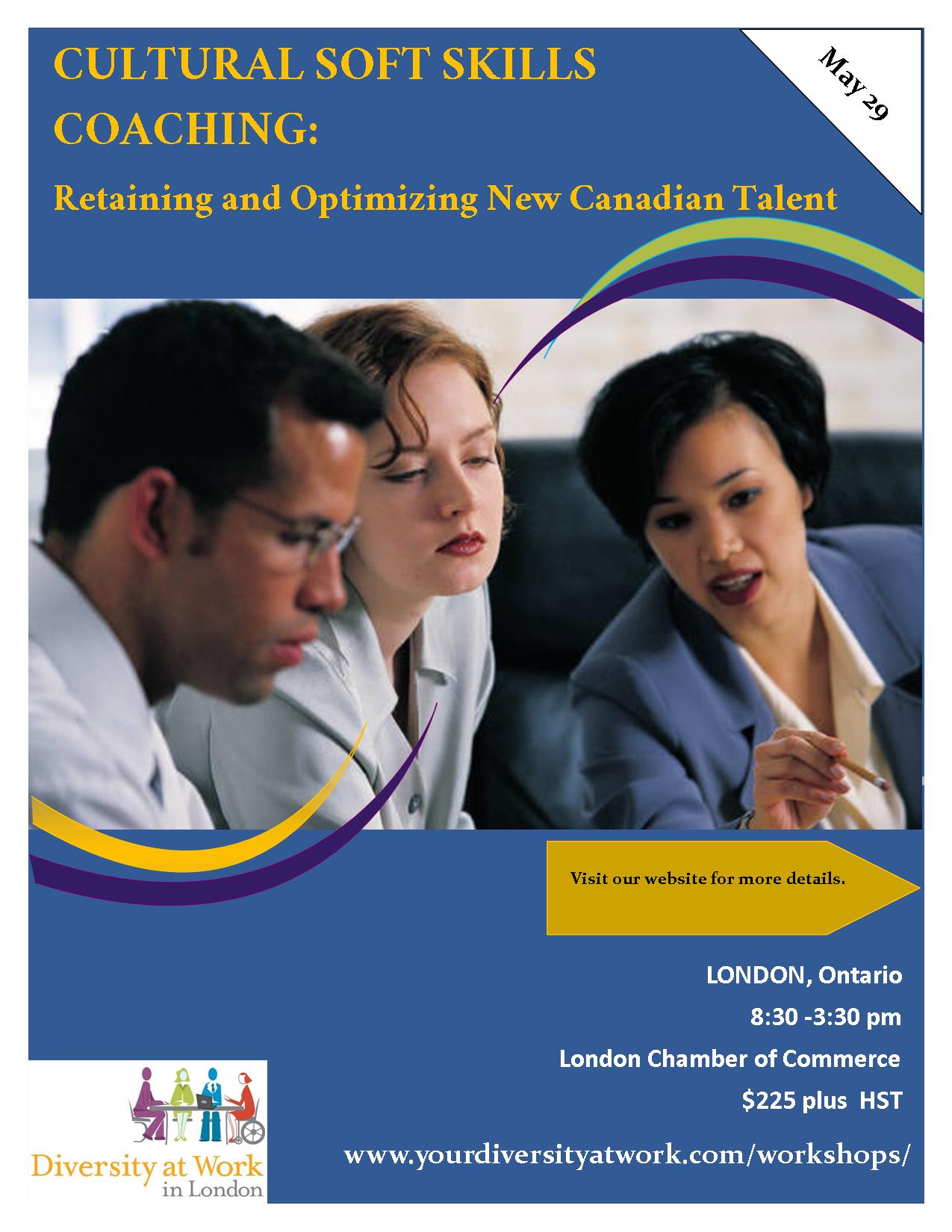
I am pleased to announce an upcoming workshop that I will be doing in London, Ontario on May 29th. It combines what I have learned over the years in: international education, coaching and mentoring New Canadians in the workplace and working directly with employers regarding their integration. If you are interested in learning how to optimize and retain immigrant talent, this workshop is for you. If you cannot make the workshop in London, we are happy to deliver it to your workplace or community. We travel anywhere, just ask.   For full details, visit our website at http://www.yourdiversityatwork.com/workshops/.

coaching

POTLUCKS AND THE POLITICS OF FOOD IN THE WORKPLACE


Evelina Silveira, President, Diversity at Work   co-author,  The No-Nonsense Guide To Workplace Inclusion

potluck[1]

While splitting the check, B.Y.O.B, potlucks, and eating leftovers from the catered luncheon are routine in a Canadian workplace; by far this experience  is not an international phenomenon. While you may think your welcoming, kind gesture to “break bread” with a New Canadian co-worker is a good idea, don’t be surprised if they have a different interpretation. Food and eating can be a highly political affair. Political? Indeed – political! Let’s take a look at one of our most popular epicurean rituals which has stood the test of time.

Potlucks

Why do we have potlucks in Canadian society? Potlucks offer an inexpensive, easy way to feed large groups of people, while providing an assortment of food the guests may have never sampled. It’s about sharing: food, workload, and preparation.

What are the beliefs that sustain potlucks in Canadian society?

  •  Cooking is a chore and not many people like it and especially when it involves trying to please a number of people whose preferences are unknown.
  • If you want to have a gathering everyone should be “pitching in” financially and effort-wise. Food and entertaining is expensive and it shouldn’t be up to one person to do all of the work.
  • It’s more fun if we all help out and we can share the joy and responsibility.
  • Hospitality doesn’t need to be formal. You can still be hospitable and casual at the same time. Everyone can be a host. It doesn’t take a lot of skill, effort or rules.

How might these beliefs clash with people who are coming from countries which are more hierarchical, formal and collectivist?

In a big way! Although the price of food has increased dramatically, it is still widely accessible and  affordable by comparison to other parts of the world. We don’t have a lot of rituals around eating except for “eating on the run”, “fast food” and “Tim Horton’s”. With a growing acceptance of vegetarian and veganism what we eat these days is less based on social stratification and more inclined to be on preference.

North Americans tend to view food in a “profane” way as the famous sociologist Emile Durkheim would probably conclude. Food is ordinary and nothing special, has no associated rituals or beliefs to preserve its “sacredness”.

This would be in sharp contrast to the many New Canadians who are more likely to view food as “sacred”. They may have grown up learning how to cook with recipes passed down from the generations, or associate foods with symbolism and rich meaning and a wider array of festivals and celebrations. Some foods may be used for medicines or spiritual healing or to bring good luck or fertility. The “sacredness” of food means the act of eating is a“sanctified ritual”. For example, Jews and Muslims will refrain from eating pork products and the meat they eat must conform to “kosher” or “halal” standards. It means that the animals are slaughtered in a religiously prescribed way to enhance the sacredness of the food and thus the sanctity of eating.
Hospitality is a lost art in North America. If you have ever shared a meal for instance with an Afghan, a Portuguese, or an Arab family – the hospitality cannot be compared. You will be treated like royalty and no effort or expense will be spared. The goal is not to make the experience easy for the host, but just the opposite. By contrast, the host wants to show you how much you mean to them by going through lots of trouble and expense. You will not feel obliged to do the dishes nor would they want you to. They want you to relax and have them entertain you. You may actually feel that they have enlisted their whole family to make you feel comfortable. The experience is formal and every action is intentional. Good hosting skills lead to many benefits including: new jobs, connections, elevated status, marriage proposals, a strengthened ability to negotiate, but most of all preserving or enhancing one’s reputation.

Are potlucks a good idea in a North American workplace? It all depends. If you want to celebrate or show appreciation for a job well done you may come across as a cheap manager or employer – an insult to your New Canadian workers. Showing appreciation and respect for employees and especially those from more formalized cultures requires: a demonstration of effort; some expense and conveying their importance in the workplace which is not a bad approach to take with all of your employees. Is it?

Actions You Can Take To Increase Intercultural Understanding in the Workplace


By:  Evelina Silveira,  President, Diversity at Work

1. Start up a Diversity Book Club or Discussion Group    You can take turns assigning a reading which is pertinent to your work and designate a regular meeting time for your discussions. Tailor it to your industry and the specific knowledge you would like to gain.
For example:
Indian-Style of Leadership – This could help organizations who have a number of New Canadian Indian employees gain an understanding of the differences in leadership style in India. It can give leaders an awareness of what some of the challenges these employees may have based on their previous work experiences and help them become more acclimatized to a Canadian workplace.
Cultural Differences in the Way Disabilities are Communicated. The way cultural groups talk about disabilities tells us a lot about their values and how people with disabilities are treated in their communities.
Plagiarism Around the World – Understanding how different countries feel about and define plagiarism is important in preparing international students for post-secondary education.

2. Spearhead Employee Resource Groups These groups can provide valuable information to advance the goals of your organization. If you happen to have a New Canadians ERG, it can be drawn upon to provide education to the rest of the employees and make suggestions for program development and provide insight into new markets.

3. Infuse Cultural Tidbits Into Existing Vehicles of Communication Whether you have an intranet, a regular newsletter or hang up posters, don’t miss out on an opportunity to encourage cultural learning. What about your staff or departmental meetings? After all, when we learn about other cultures, we learn a lot about ourselves!

4. Examine Your Corporate Social Responsibility Initiatives Is there a way you can increase your interactions with some of the major cultural groups in your community? Volunteer at a settlement agency? Be a mentor? Consider sponsoring cultural events.

5. Increase or Begin to Offer Student Placements/ Co-ops Work with local agencies serving diverse clientele and post-secondary institutions to bring diverse workers to your organization. You will be amazed at how much you learn from the experience!

6. Take a Cultural Competency Inventory Ask employees if they have: knowledge of a second language, experience from work abroad and cross-cultural education. Having this information handy can be a real help when you are considering the appropriate people for foreign assignments or need some emergency assistance with a culturally diverse client who you are having difficulty communicating

Multilingualism: An Essential Ingredient of Culturally Competent Healthcare


Image

By: Evelina Silveira, President, Diversity at Work in London Inc, Publisher, the Inclusion Quarterly

Everyday occurrences and unprocessed feelings usually form the basis of my blogs. Today’s is no different. It is Tuesday, and I am still thinking about the elderly Italian woman I saw over the weekend in a long-term care facility and left wondering: Is there a better way to meet the needs of residents who do not speak English?

I don’t know Rosa (name changed to protect her identity) but I do know that she is Italian as I recognize some of the words she yells or her conversations to imaginary people. No one understands what she is saying and nurses and attendants just continue to speak to her in English, or they ignore her completely because they just don’t know how to communicate with her. Residents will refer to her as “the crazy one” or the “one who is always screaming”. I only know a few words in Italian, but I happened to recall the expression, Che bella ragazza. I decided to look directly at her and say these words to her, checking to see if there was a response. For a moment, she paused as she appeared to hear something familiar and I only had wished I could remember more. I had just referred to her as “a beautiful girl!”  Her face temporary lit up and my heart was warmed. If only, I could have a conversation with her, I thought.

I had to wonder, what was it like for her to be in a home where no one understands her. How frightening to become invisible and voiceless. What a disappointing way to end the remaining years of one’s life.

The need for multilingual staff and volunteers is extremely important in effective healthcare delivery. As more immigrants are entering these facilities, I believe that we could be at a crisis point if we do not do more to address this issue especially in long-term care. Even though the immigrant resident may be fluent in English, for reasons I don’t understand they will often resort back to their mother tongue especially as dementia sets in.

While it may be impossible to have staff who can speak all the languages the residents do, there should be more effort made to provide care to them in their own language.

Here are some recommendations for providing more multilingual services in long-term care.

Employee Recruitment . Research the demographics of your community and include foreign language competencies in job postings based on what you find and on your current service needs.

Libraries and Print Materials. Consider purchasing or asking for donations of multilingual books, periodicals and tapes that residents can enjoy. Add international media.

Foreign Language Training.  There are many low-cost and no-cost ways of learning another language. Conduct a Google search and you’ll find many that are free.

Create a Picture Dictionary With Basic Words and Salutations. These small gestures could go a long way with keeping the resident more stimulated in addition to increasing the competencies of the employees.

We are facing unprecedented changes in healthcare and creating more culturally competent organizations do not have to be costly. Using existing community resources and becoming more innovative in the recruitment, selection and retention of employees can go a long way with developing more inclusive services.


The Complicated Dynamic of Racism in Long Term Care


Holding Hands with Elderly Patient


By:  Evelina Silveira, President,   Diversity at Work in London Inc. and author of  Diversity and Inclusion on A Budget:  How to have a more engaged and innovative workforce for little or no dollars.

Go to almost any long term care facility in the London, Ontario area and the racial divide will be very visible when it comes to who is a  front-line worker versus a resident.  Race and ethnicity become very pronounced.  British name plaques sprinkled with a few Southern European ones grace the corridors of the residence.  These facilities are home to a largely female population, and the leadership is usually comprised of women of British origin.

When we look more closely however, we will see that visible minorities form a good part of the staff involved in direct service delivery.  In London, this means primarily Filipino, Sudanese, Ethiopian, Eritrean, Latin American and Eastern European women.  For the most part, the residents have had very little contact with these groups and are unfamiliar with them, and consequently   deep-rooted racism, prejudice and stereotypes are not uncommon.

We have to remember that the cultural and racial demographics did not change much until the mid 1980’s in London, Ontario.  These residents probably did not grow up, live alongside and work with people who looked different, sounded different and did things differently.   It should be expected that they may have feelings of discomfort when they are in such a vulnerable position when they have to rely on these workers for so much of their basic care and sense of safety.

However, this lack of comfort can lead to racism causing devastating consequences for these workers.  False accusations, physical assaults against the workers and racial slurs can all be hurled at the people who are entrusted to look after them.  Feeling powerless, and afraid to report any problems for fear of losing their job, many minority workers have to face the additional brunt of racism while they go about their jobs caring for our family members in low paying positions with little opportunity for advancement.

Administrators will note that while many residents may keep their racial intolerance to themselves, if they are struck with dementia their filter is often lost.  It means that racial minorities who work in dementia services will deal with the effects of racism to an even larger degree.  It is a very slippery slope as we cannot punish people with dementia for what they say, so what do we do?

There is very little in the research about what might be the best solutions to the problem of racism against direct care workers in senior residences.  It can be challenging because long term care is a resident’s home. To complicate matters, residents who are hard of hearing report real challenges understanding those who have heavy accents.  But can long term care facilities be doing more to embrace the diversity of their staff?  The answer is yes.  Here are a few suggestions, but we need more.

 1.   Advertise languages spoken at your long-term care facility. –  Use your website, boast about it in your pamphlets and create a welcome sign for your front lobby that is multi-lingual and showcases the languages spoken.

 2.  Have multicultural displays.  Work with families, residents and employees to showcase various cultures in your lobby.  You might want to designate a multicultural week where you could have display tables that residents and family members could preside.  This is a great way to let everyone know that your home respects and celebrates culture.  Don’t forget to include posters that show respect for diversity and inclusion.  Include a few new food choices.

 3.  Solicit ideas for new recreational activities.  Do you have a resident who enjoys working on a craft project that is unique to     their  country of origin?  Would they be interested in teaching others how to do it?  Your multicultural staff could provide insight into some foods, outings, music and crafts.  The possibilities are endless; all the while learning about one another can be fun.

4.  Intake Assessments.   It is important to let residents and family members know about respect policies that you may have regarding your employees.  Depending on the resident’s health condition they may or may not be able to adhere to them. Ensure that you include some culturally based questions about:  values, end-of life decisions, language spoken.

 5.  Onboarding for New Employees – Ensure that all employees are told about the supports that are available to them when it comes to any bullying, harassment and racism.  Racism can take a toll on a worker’s mental health and performance, and they need to know what it looks like and where they can report it without jeopardizing their job security.   The leadership needs to take reports of racism seriously and be prepared to create a work plan that can protect them that is respectful to the worker and the resident’s rights.

6.  Take a Team Approach.  While little can be done to change the behaviour of elderly residents, a lot can be done to create a supportive team environment for the person who is experiencing the racism, reducing some of the negative effects.  Workers may be assigned to work in pairs to deal with difficult residents or be removed from dealing with the problematic client altogether.  Communication is the key.  Remember to involve the worker in the plan.   Leaders should also take a proactive approach to speak with the resident if they are coherent and finding out what their concerns are.  The resident may have some legitimate concerns that may be wrongfully dismissed as racism.  However, if racism is the issue this is an opportunity for the leaders to demonstrate to the resident that the worker is qualified to do the job just as the rest and should be treated with the same respect.  This is an important action the leader must take to demonstrate to the worker that their concerns are treated seriously and that while he/she may not have the confidence of the resident their boss believes in them.

If your organization has faced similar situations, please leave us your comments about what worked.


  • Sensitivity Empathy Training for Workplace Bullies

  • Enter your email address to follow this blog and receive notifications of new posts by email.

  • Workplace Inclusion and Customer Service Publications

  • Anti-Bullying and Harassment Training for Groups

  • Learn more about our English as a Foreign Language Coaching for Business Success

    Teacher Pointing at Map of World ca. 2002

  • Follow me on Twitter