Webinar: Understanding and Responding to Intercultural Conflict


July 10 or 16, 2020

With global business communications and diverse workplaces increasing, intercultural conflicts and misunderstandings are bound to happen.
Ethnocentric approaches  mistakenly  assert that all conflicts are pretty much the sameiand should be handled similarly. But, this is ineffective and does not take into consideration the uniqueness of various cultures.
Intercultural conflicts are different. 


Hone your cultural competencies skills and  learn to look at intercultural conflict from a ethnorelative lens.
In this webinar you will:

  • Learn how differences in cultural perceptions can trigger discord.
  •  Theories of intercultural conflict.
  •  Figure out if a conflict is culturally-based.
  •  Gain strategies for dealing with intercultural conflict when it arises.
  •  Understand how different cultures approach and resolve conflicts.   
  • Ways of preventing or minimizing intercultural conflict in the future.
  • Obtain specific questions for mediating intercultural conflicts in the workplace.

This is a condensed version of a one-day workshop.  
If you want to improve the communication skills among your global teams, culturally diverse clients or staff, this is for you!

Learn more and register:

https://www.diversityatworkcommunications.com/webinars

The “Over-Qualified Bias”: What does this mean to employers and candidates?


MP900443225[1]Evelina Silveira, President, Diversity at Work in London,co-author  The No-Nonsense Guide to Workplace Inclusion

The topic of implicit bias has become increasingly popular in diversity and inclusion discussion circles.  Racial, gender, ability, age, cultural and other biases often play a part in deciding whether a  candidate is interviewed, offered, retained and promoted in a job.  Have you ever taken into account that an “over-qualified” label can also have serious ramifications for both your organization and the candidate?

With global unemployment as an epidemic, it naturally makes sense that many applicants may apply for work they have done before, with ease and for an extended period of time.  When these individuals then go to apply for a job which  is similar to what they have done before they are considered “over-qualified” and thus overlooked.  When employers go the “over-qualified” route, they believe that this is a nice way to let applicants down; telling them in a nutshell – “you are too good for this job”.

Next time you consider dismissing an applicant because they are “over-qualified’ it is worth reflecting on the following points:

  1.  The candidate applied for the job and this means they are interested just as any other.
  2.   You may think they are overqualified but they might feel otherwise.
  3.   They may be fine with lateral moves – not everyone wants to climb the corporate ladder.
  4.   They are looking for a less stressful job that they can balance more easily.
  5.   They have outside interests which they may want to devote more energy; and that is why they have chosen to apply for a job which they can perform easily.
  6.   An overqualified candidate can be your best asset. They can bring industry experience which can help your organization soar.
  7.   Do you want to eliminate a candidate from the pool because you fear they will take your job?
  8.   Different people approach work differently. This means that the candidate may find a new way of doing the work that will make it more stimulating and thus more inclined to stay.
  9.   You may be getting more value for their work.
  10.   Over-qualified is a label associated with mature workers. Could you be prejudicing the employment of mature workers?
  11.   Not all over-qualified people demand high salaries which is an assumption that is made all to often.

Before you think a candidate will be “bored in a second and gone in a minute” try some probing questions in the interview to determine whether the risk is high.

  1.   Where do you hope to be in 2 years?
  2.   What are you hoping to learn in this job?
  3.   What motivates you at work?
  4.   What is the ideal job for you?
  5.   What are you looking for in a job?

You may find the job is a perfect match for the candidate you have slotted as “over-qualified”.  There is no guarantee anymore that an employee is going to stay with a company for 10 years.  But realistically, job seekers are not doing a lot of job hopping when there are few options to go to.  If you are concerned their skills are not adequately being used asked them for suggestions.  With work experience under their belt they may make a fantastic mentor which is an exceptionally good way to recognize their value.


CHRR2159-16 HR_readers choice_div-emp-equity

The Guide to Workplace Inclusion


Preview and Purchase at www.yourdiversityatwork.com/ebook/

Read  below what others have said about our book:

linked in

ENDORSEMENTS:

This is an important and timely book for those who want more inclusive workplaces. It moves seamlessly from concepts and terminology and translates them into practical and actionable ideas. All readers, no matter where they are on their diversity and inclusive journey, will find something valuable in this book. Evelina Silveira and Jill Walters have created an impressive resource that includes examples of promising practices from across the globe. This should be every HR professional’s companion!

~Ratna Omidvar, executive director, Global Diversity Exchange, Ted Rogers School of Management, Ryerson University

The No-Nonsense Guide to Workplace Inclusion provides a thorough and engaging roadmap of the journey toward organizational inclusion. The authors write from a position of rich, credible experience, with the result that this Guide can help companies capitalize on opportunities and skirt problems on the road to fuller inclusion of an increasingly diverse workplace. Filled with examples and evidence-based solutions, this Guide is a valuable tool for any organization working on building and strengthening its culture of inclusiveness.

~Alison Konrad, PhD, professor of organizational behaviour, Ivey Business School, London, Canada

Managing diversity and creating inclusive workplaces can seem like a daunting challenge for many organisations, but Evelina and Jill have produced a really accessible, highly practical guide to help organisations get going. What we particularly liked was that it was packed full of real examples and illustrations and lots of useful links and tools.

~Tracy Powley, director, Focal Point Training and Consultancy Ltd, United Kingdom

Because inclusion is one of the core values of the USTA, it is important for me to lead, motivate and work well with individuals of diverse backgrounds, capabilities and interests in order to achieve the outcomes we’ve set for ourselves. This book is a great resource for any organization looking to create a successful culture of inclusion.

~D.A. Abrams, chief diversity & inclusion officer, United States Tennis Association/ author, Diversity & Inclusion: The Big Six Formula for Success

This book goes a long way in addressing the systemic discrimination faced by the LGBTQ2 community in the workplace. It tells you what you need to do and gives you the resources to do it. It makes it easy for any workplace to become more inclusive in their hiring, recruitment and retention practices. I highly recommend it for every workplace.

~ Deb Al-Hamza, past president, Pride London Festival/ diversity social worker, Children’s Aid Society of London & Middlesex

I think this book is very comprehensive! There is very valuable information from ‘Foundations for creating an Inclusive Business Environment’ to ‘Best Practices in Diversity.’ I see the value for small to medium businesses that lack a dedicated human resources professional or lack the experience with implementing policies and procedures to promote an inclusive environment; however, larger businesses can also benefit greatly from the examples, detail and strategy offered. I will continue to visit many of the resources offered in the future and have made note of some of the examples.

~Lesley Oliver, diversity & accessibility coordinator, Equity & Human Rights Services, University of Western Ontario

The book is strategic, concrete and to the point. The various examples make it relevant to readers and practical. I also like the fact it is rooted in personal experiences and takes a holistic approach. The book makes one reflect on what is not obvious, helps avoid assumptions and discusses unconscious bias.

~Magali Toussaint, international career and cross-cultural coach/ diversity professional, Netherlands, http://about.me/magali.toussaint


Coaching New Canadians in Soft Skills: How do you do it?


Evelina Silveira, President, Diversity at Work in London Inc.

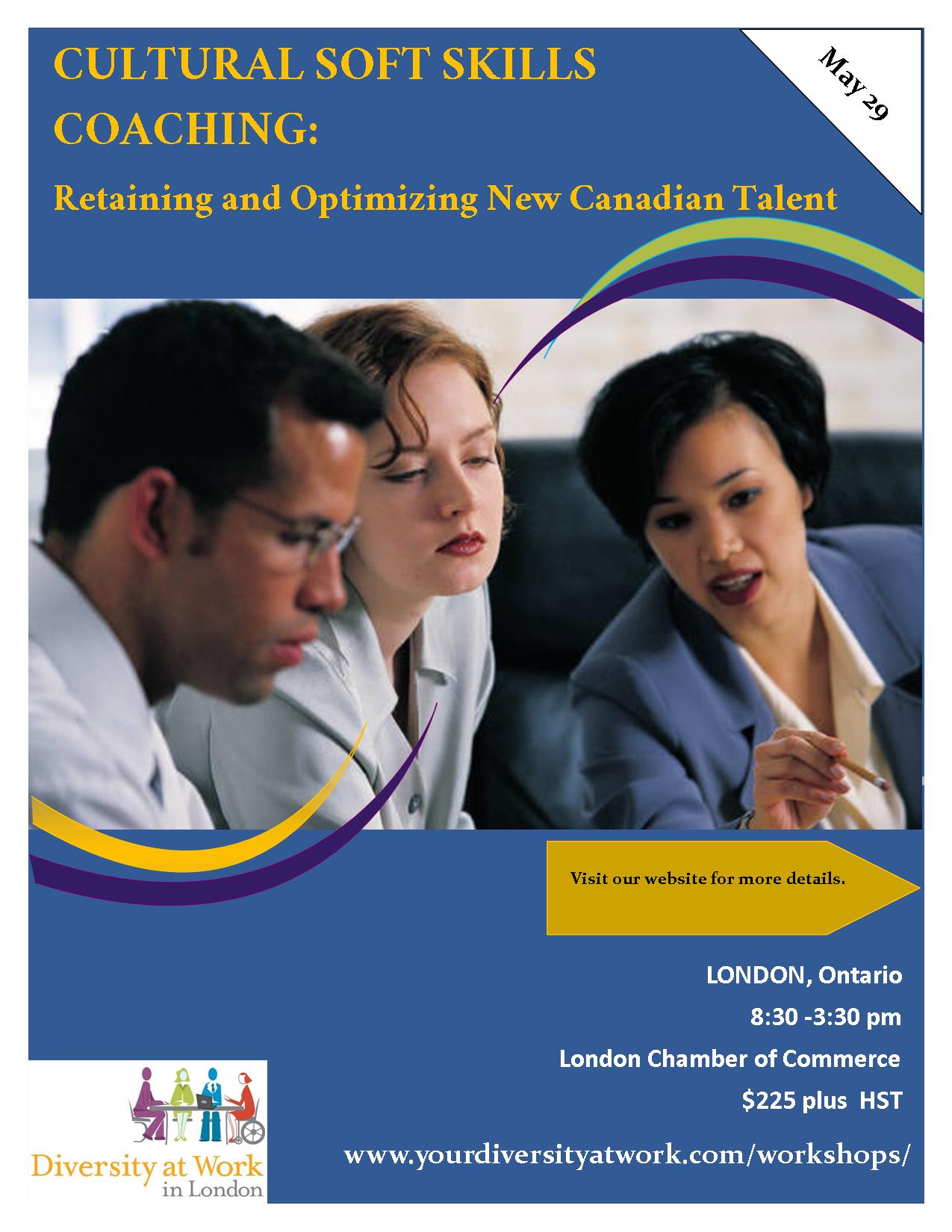
I am pleased to announce an upcoming workshop that I will be doing in London, Ontario on May 29th. It combines what I have learned over the years in: international education, coaching and mentoring New Canadians in the workplace and working directly with employers regarding their integration. If you are interested in learning how to optimize and retain immigrant talent, this workshop is for you. If you cannot make the workshop in London, we are happy to deliver it to your workplace or community. We travel anywhere, just ask.   For full details, visit our website at http://www.yourdiversityatwork.com/workshops/.

coaching

“You Just Don’t Fit In!”


By:  Evelina Silveira, President Diversity at Work in London Inc.  Publisher, Inclusion Quarterly

The interview has ended and you turn to the other members of your selection team and say: “He wouldn’t fit in” and they agree, passing over this candidate in favour of a less qualified one. You site all kinds of reasons like: “he is too old”, “we want people who will be fun to work with and he seems too professional”, he seems to know more than we do”, and his cultural dress wouldn’t fit the corporate image we’ re trying to project. All of these are poor excuses for turning down a candidate especially if they are qualified for the job. Telling someone “they don’t fit in is a proclamation of personal bias. Period. The ideal staff person cultivated in your head does not match the person sitting in front of you. Perhaps you were looking for a man? Someone who is of the same race as you? Or a person who doesn’t have a disability?  Were you specifically seeking a straight candidate?  You wanted someone under the age of 40?  A person who thinks like you? Someone who is less intelligent and won’t challenge you in any way?  Or who seems to lack confidence?

I remember getting hired for a job when my manager was on holidays. Figuring out that she would not want to consider me for the job because of my experience, I later learned the selection team strategically held the interviews while she was away. I was 35 and she was used to working with young women who were fresh out of school. Having been through the trenches of the not-for-profit world, I was full of enthusiasm and ready for the challenge of re-energizing a fledgling program. Introduced to me after coming back from her vacation, she declared: “I wanted someone who was younger and who I could mould”! Can you imagine how I felt? Clearly, I did not “fit” her ideal image of the staff she wanted to have, even though there was absolutely nothing wrong with my work.

Recently, my friend recounted a similar situation about an interviewer. Noting that she liked having young energetic staff, she  conveyed she was impressed by his many years of experience, but  added: I just need to know that you will fit in, because everyone fits in here and I am not so sure about you”. He thought it was an odd comment to make, but decided that he would just forget about it. After getting hired, in his first week, his boss called him into her office and had some peculiar personal comments about him that had nothing to do with his work. He’s a rather introverted man who is reserved until he gets to know people.  She said: I am really not sure you are fitting in”. You keep your door closed and you are not really interacting much with the staff”. You seem really unsociable!” B. had his door closed to block out the noise to accommodate his disability, ADHD.  This was mentioned  during his interview. While he was friendly to all staff,  he wasn’t hanging around in the hallways or in their offices gossiping as so many others were. He had a work ethic! Apparently, that was why he “wasn’t fitting in”?
If you are making hiring and retaining decisions not based on a person’s ability to do the job, but on something about them you don’t really like, (which is really what “not fitting in” is all about) this is a bad move that could end up costing you a bundle in legal fees.

As an employer you could easily be playing with fire when it comes to human rights, legislation protecting people with disabilities in the workplace and laws against bullying and harassment.

Hiring someone because they are the best person to do the job is always the right decision and having standardized documentation to support all phases of the hiring process is the way to go.

Next time, you think “that person doesn’t fit in”, challenge yourself to look at what they do bring to the workplace instead of imposing unnecessary superficial expectations on them. Take the time to understand what is happening for them. After all, a good leader makes everyone feel included no matter how different they are. It is up to you to help them “fit in” and be accepted and respected.

Quick and Easy Ideas for LGBT Workplace Inclusion


Image

Evelina Silveira, President, Diversity at Work in London Inc.  Author, Diversity and Inclusion on a Budget:  How to have a more engaged and innovative workforce with little or no dollars.

Pride Month is coming up and now is the time to take a look at what your organization is doing to create workplace inclusion for lesbian, gay, bi-sexual, and transgendered employees.  Even though I am a big supporter of LGBT inclusion in the workplace and in the community at large, sometimes I find myself stumped at what can we do in our organizations to advance the cause?  I figured that there were other people out there who likely feel how I do, but don’t know where to begin.  I did some research and I came up with a few ideas below that are really quite easy to do.  You don’t have to have a big budget, but you will see that these ideas will no doubt contribute to a more caring, engaged and productive workplace.

  • Don’t assume everyone is straight.
  • Remember to communicate a zero tolerance policy that inappropriate comments or jokes will not be allowed.
  • Keep in mind that LGBT employees often have children, spouses and partners. Show interest in their lives as well.
  • “Coming–out” is usually a risky thing to do in the workplace. When someone shares this with you, thank them for their trust in you and honour their need for privacy.
  • Convey verbally and in writing that professional development and promotional opportunities are solely based on merit.
  • When you are embarking on diversity and workplace inclusion training remember to include LGBT content.
  • Include any policies or benefits to LGBT employees on your website as you would for other groups. In the case of a global operation, it is important to let employees know how LGBT company practices and societal approaches abroad may be different if a transfer or travel is involved.
  • Don’t overlook LGBT causes when you are looking for outreach opportunities in your community. Considering the prevalence of bullying and higher levels of suicide among LGBT youth, these groups could use more resources.
  • Send out a Happy Pride Month message in your newsletter, intranet or other form of communication, just as you would with any other special month.
  • Ask employees if they have any ideas to improve LGBT inclusion in the workplace or marketing/customer service efforts to this population. These questions should be posed to your employees in general and not singling out LGBT in your organization.


If you would like more easy and low-cost ways to make your workplace more inclusive, consider purchasing our eBook, Diversity and Inclusion on a Budget  at http://www.yourdiversityatwork.com/ebook/ .


  • Sensitivity Empathy Training for Workplace Bullies

  • Enter your email address to follow this blog and receive notifications of new posts by email.

  • Workplace Inclusion and Customer Service Publications

  • Anti-Bullying and Harassment Training for Groups

  • Learn more about our English as a Foreign Language Coaching for Business Success

    Teacher Pointing at Map of World ca. 2002

  • Follow me on Twitter