What the Brits’ Telly Can Teach Us About Diversity Dialogues


tv

Evelina Silveira,  President, Diversity at Work

When you think about British television, what comes to mind?  Well, if you are not British most of us would probably say Coronation Street  because it has been around forever on Canadian televisions. But there is so much more to discover!  Deciding to join the cable cutting crowd, I have opted for YouTube instead, for my nightly viewing. And British TV is it!

I have been so impressed with the wide range of British television programs devoted to social experiments in the form of reality TV.  To their credit, it appears the Brits are sincerely trying to understand “the other” through their programs of cultural exchanges of various sorts.  They’re not your regular run-of-the-mill low budget reality programs but thoughtful, out-of-the-box productions that are not afraid to ask the tough questions.

Why do I find the programs to be so remarkable?  Because the participants in the social experiments get a chance to “walk in the other person’s shoes” and freely ask questions without being afraid of a label of “homophobe”, “racist”, “islamaphone” “xenophobe” etc.  You get to see the good, the bad and the ugly.  Nothing is held back and I like that.  At least, when everyone has their preconceptions on the table you have something to work with instead being terminally superficial and polite.

What I began to notice in British television was delightfully refreshing.  The Brits actually engage others in a conversation about diversity.   I don’t see that happening in Canadian television.  All  we ever see is one side of a story and you either accept it or you don’t.  There is rarely an opportunity for two groups to come together and learn about one another and gain sensitivity, empathy and insight into the other group’s world.  The Brits seem to love programs devoted to “social experiments” and I have to tell you as a lover of sociology and anthropology — these types of programs score high for me.

It must have been a television genius who came up with the subject matter.  I have watched at least one  episode with the following themes:

  • A small group of Brits who have to live like a Muslim for a designated period of time.
  • Six men from a variety of backgrounds and lifestyles who go to live in a Benedictine monastery and must follow their rules
  • Nasty British teenagers who are sent to live with an American Amish family to help them reform their ways
  • Bad behaving British teenagers who are sent to live with another family in a foreign country which is known to be “very strict”
  • Several English citizens who feel they have been negatively impacted by immigration are matched with immigrants to challenge some of their assumptions

What so good about these experiments? What do participants often learn from the experience?

  • There is greater understanding that can come from honest and often challenging conversations. You might either become stronger in your conviction or  more empathetic to the other’s experience.
  • There is value and meaning in learning about other people’s rituals even if they seem far off.
  • We can be enriched by others’ experiences and might find adopting aspects of their lives to our own.
  • Having your assumptions challenged is not a bad thing and it contributes to your own personal growth.  You can also help others grow by letting them express their biases/stereotypes and prejudices and work with them.
  • You can’t live in a liberal democracy without expecting to be offended occasionally: a price of freedom of expression.

For example, in the BBC documentary a young British-born  worker is matched to a Polish immigrant who owns his own construction business.  The young man contends foreigners are taking all of the jobs.  He gets to meet Mariuscz  a business owner and notices that his whole shop is full of only Polish workers which fuels his negative perception.   However, when he has a conversation with Mariuscz he realizes that these workers have a starting wage which is much lower than he would accept.  Mariuscz says he started at a low salary and worked his way up in a shop and finally decided to open his own business.  Mariuscz however is challenged to see that hiring only Polish workers is discriminatory and that he could benefit from English-speaking employees.  He is open to accepting this criticism and comes to see that his workers would learn English if there was someone around who would be prepared to speak it.  The result of this dialogue?  I would say a win-win for both participants.  Each was open to hearing the other’s point of view and challenge their own thinking.

British television shows me how much we Canadians have in common  However, I would have to say a few programs that I watched momentarily would never survive in Canada.  They are just too mean! Programs like Fat Families and Life on the DoleLife on the Dole  does not seem balanced at all.  Most of the cast consists of drug addicts, people who don’t want to work and ex-cons.  We don’t see many examples of the working poor.  If the purpose of Life on the Dole  is to make working people angry about the poor, than it succeeds in that regard.  If this program was filmed in Canada the slant would be different.  It would be aired to bring about empathy and awareness of the poor and set in a more compassionate light and with less of a classist tone.

All in all, British television rocks!  I need to run —-  Wife Swap UK is on!


Coaching New Canadians in Soft Skills: How do you do it?


Evelina Silveira, President, Diversity at Work in London Inc.

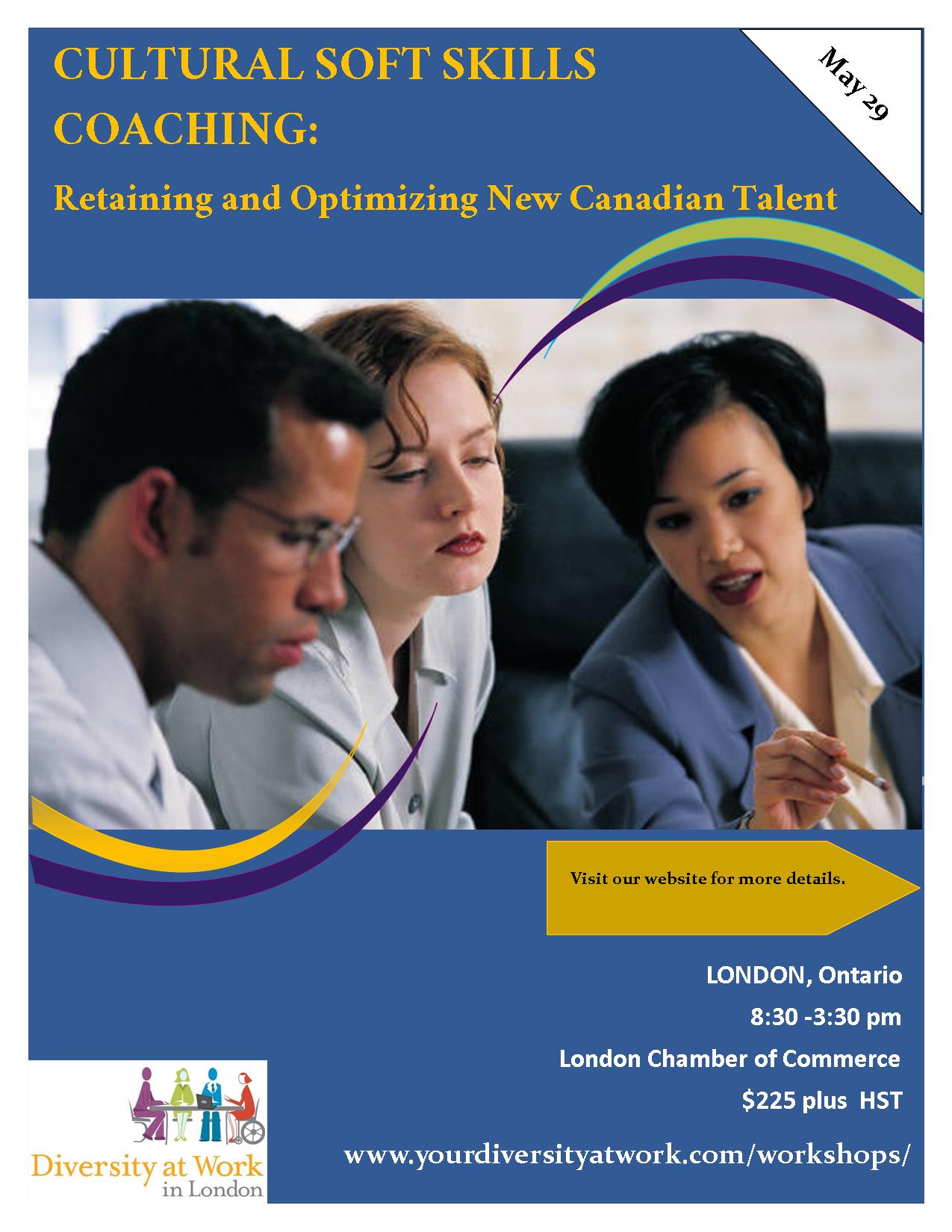
I am pleased to announce an upcoming workshop that I will be doing in London, Ontario on May 29th. It combines what I have learned over the years in: international education, coaching and mentoring New Canadians in the workplace and working directly with employers regarding their integration. If you are interested in learning how to optimize and retain immigrant talent, this workshop is for you. If you cannot make the workshop in London, we are happy to deliver it to your workplace or community. We travel anywhere, just ask.   For full details, visit our website at http://www.yourdiversityatwork.com/workshops/.

coaching

POTLUCKS AND THE POLITICS OF FOOD IN THE WORKPLACE


Evelina Silveira, President, Diversity at Work   co-author,  The No-Nonsense Guide To Workplace Inclusion

potluck[1]

While splitting the check, B.Y.O.B, potlucks, and eating leftovers from the catered luncheon are routine in a Canadian workplace; by far this experience  is not an international phenomenon. While you may think your welcoming, kind gesture to “break bread” with a New Canadian co-worker is a good idea, don’t be surprised if they have a different interpretation. Food and eating can be a highly political affair. Political? Indeed – political! Let’s take a look at one of our most popular epicurean rituals which has stood the test of time.

Potlucks

Why do we have potlucks in Canadian society? Potlucks offer an inexpensive, easy way to feed large groups of people, while providing an assortment of food the guests may have never sampled. It’s about sharing: food, workload, and preparation.

What are the beliefs that sustain potlucks in Canadian society?

  •  Cooking is a chore and not many people like it and especially when it involves trying to please a number of people whose preferences are unknown.
  • If you want to have a gathering everyone should be “pitching in” financially and effort-wise. Food and entertaining is expensive and it shouldn’t be up to one person to do all of the work.
  • It’s more fun if we all help out and we can share the joy and responsibility.
  • Hospitality doesn’t need to be formal. You can still be hospitable and casual at the same time. Everyone can be a host. It doesn’t take a lot of skill, effort or rules.

How might these beliefs clash with people who are coming from countries which are more hierarchical, formal and collectivist?

In a big way! Although the price of food has increased dramatically, it is still widely accessible and  affordable by comparison to other parts of the world. We don’t have a lot of rituals around eating except for “eating on the run”, “fast food” and “Tim Horton’s”. With a growing acceptance of vegetarian and veganism what we eat these days is less based on social stratification and more inclined to be on preference.

North Americans tend to view food in a “profane” way as the famous sociologist Emile Durkheim would probably conclude. Food is ordinary and nothing special, has no associated rituals or beliefs to preserve its “sacredness”.

This would be in sharp contrast to the many New Canadians who are more likely to view food as “sacred”. They may have grown up learning how to cook with recipes passed down from the generations, or associate foods with symbolism and rich meaning and a wider array of festivals and celebrations. Some foods may be used for medicines or spiritual healing or to bring good luck or fertility. The “sacredness” of food means the act of eating is a“sanctified ritual”. For example, Jews and Muslims will refrain from eating pork products and the meat they eat must conform to “kosher” or “halal” standards. It means that the animals are slaughtered in a religiously prescribed way to enhance the sacredness of the food and thus the sanctity of eating.
Hospitality is a lost art in North America. If you have ever shared a meal for instance with an Afghan, a Portuguese, or an Arab family – the hospitality cannot be compared. You will be treated like royalty and no effort or expense will be spared. The goal is not to make the experience easy for the host, but just the opposite. By contrast, the host wants to show you how much you mean to them by going through lots of trouble and expense. You will not feel obliged to do the dishes nor would they want you to. They want you to relax and have them entertain you. You may actually feel that they have enlisted their whole family to make you feel comfortable. The experience is formal and every action is intentional. Good hosting skills lead to many benefits including: new jobs, connections, elevated status, marriage proposals, a strengthened ability to negotiate, but most of all preserving or enhancing one’s reputation.

Are potlucks a good idea in a North American workplace? It all depends. If you want to celebrate or show appreciation for a job well done you may come across as a cheap manager or employer – an insult to your New Canadian workers. Showing appreciation and respect for employees and especially those from more formalized cultures requires: a demonstration of effort; some expense and conveying their importance in the workplace which is not a bad approach to take with all of your employees. Is it?

  • Sensitivity Empathy Training for Workplace Bullies

  • Enter your email address to follow this blog and receive notifications of new posts by email.

  • Workplace Inclusion and Customer Service Publications

  • Anti-Bullying and Harassment Training for Groups

  • Learn more about our English as a Foreign Language Coaching for Business Success

    Teacher Pointing at Map of World ca. 2002

  • Follow me on Twitter